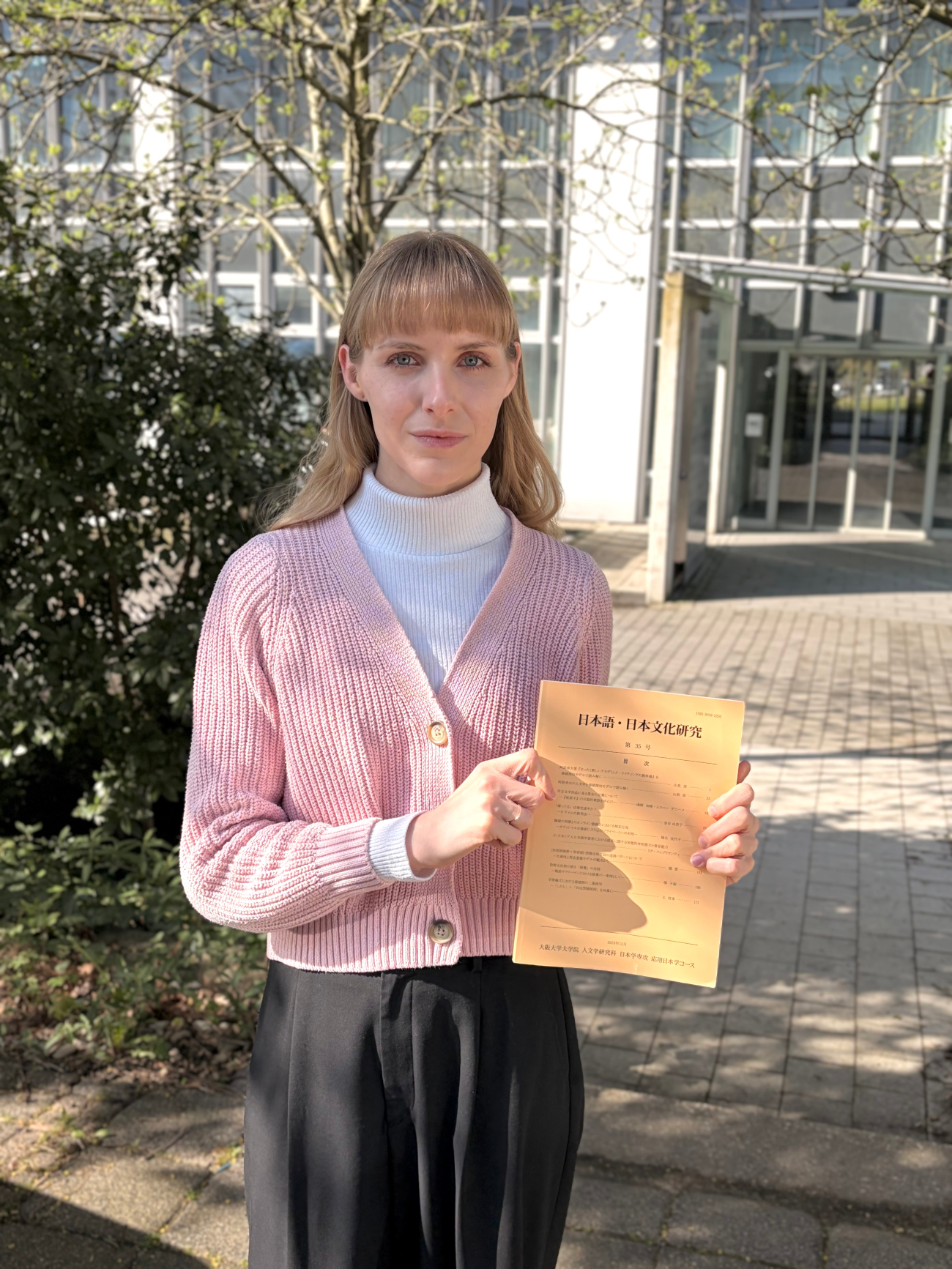
Former Qualifying Fellow Denise MUẞMANN of the Research Training Group GRK 2833 “East Asian Futures” has co-authored a paper titled “Women’s Language and Men’s Language in Japanese Heian Literature: Focusing on Diary Sections of The Pillow Book”, together with Dr. Tomoaki KŌNO (University of Osaka). The paper draws on research Ms. MUẞMANN conducted during a stay at the University of Osaka when she was a Qualifying Fellow in 2025. For the Research Training Group, Ms. MUẞMANN commented on her experience that lead up to the publication:
In early autumn of 2024, during a conversation on my one-year long participation as a Qualifying Fellow, Professor MOLL-MURATA suggested that I conduct a research project during my semester aboard at the University of Osaka (OU). This conversation was the impetus that motivated me to choose the Independent Study course of the short-term exchange programme called OUSSEP, in which I was enrolled for my semester at OU. The project began with a successful application, which required a detailed research proposal and the naming of a suitable supervisor. The latter role was to be performed by Dr. Tomoaki KŌNO 鴻野知暁 of the Division of Japanese Studies at the Graduate School of Humanities.
The working title of my project was different initially, as I had originally intended to focus on Murasaki Shikibu’s 紫式部 Genji Monogatari 源氏物語 and Sei Shōnagon’s 清少納言 Makura no Sōshi 枕草子, respectively. Although, after my first meet-up with Dr. KŌNO at Suita Campus in Osaka in the second week of April in 2025, we decided to narrow down the scope of my research to the Makura no Sōshi. This did not, however, alter the central questions that I sought to investigate, namely: How far do linguistic ideologies related to gender differences in language use reach back in history? Was there already some awareness of “feminine language”? If gender differences in language can be detected, what do they signify? Did the concept of “women’s language” exist in ancient and medieval Japan? How did women speak in the context of their social roles?
I had a great experience conducting research under the supervision of Dr. KŌNO, who was always willing to help, offering me valuable advice and suggestions for literature that proved helpful for my research. Moreover, he also gave me the opportunity to attend his classes. I vividly remember one of his Friday lectures, during which I presented the progress of my research project several times. He suggested publishing an academic paper based on my research project, with me as a co-author, and I gratefully accepted. This moment marked the beginning of the process that ultimately resulted in the publication of our article in the academic journal Studies in Japanese Language and Culture.
The paper was made available in Japanese in December 2025 as part of Vol. 35 of the academic journal Nihongo, Nihon bunka kenkyū 日本語・日本文化研究 [Studies in Japanese Language and Culture], which is published by the Department of Applied Japanese Studies at the Graduate School of Humanities of the University of Osaka. The Research Training Group warmly congratulates Ms. MUẞMANN for her successful publication and looks forward to her future academic activities.
KŌNO Tomoaki 鴻野知暁 / MUẞMANN, Denise ムスマン デニース (2025): “Chūko bungaku sakuhin-ni miru danjo-no kotoba-ni tsuite: ‘Makura-no sōshi’-no nikkiteki shōdan-o chūshin-ni” ―中古文学作品に見る男女の言葉について―『枕草子』の日記的章段を中心に― [Women’s Language and Men’s Language in Japanese Heian Literature: Focusing on Diary Sections of The Pillow Book]. In: Nihongo, Nihon bunka kenkyū 日本語・日本文化研究 35, 64–86. DOI: 10.18910/103792.
Synopsis
The way language is used is not a simply a matter of individual choice, but is influenced by various factors such as age, gender, social class, interpersonal relationships, and even time and space. Pioneering research by linguists such as William Labov and Joshua Fishman has drawn attention to the correlation between society and language. This has resulted in numerous works building on Labov’s and Fishman’s research, which emphasises the idea of gender differences in language use. This trend is also evident in Japanese linguistic, as can be seen from the numerous contributions focusing on Japanese women’s and/or men’s language. While prior scholarship has examined gendered speech norms imposed on women through conduct books in Japan’s medieval age, less attention has been given to the classical age.
To contribute to the study of linguistic gender differences found in the Japanese language and their links to social (gender) ideologies and linguistic practice, this joint-research investigates gendered language use found in dialogue sections of literary works from the Heian period, focusing particularly on the diary-style passages of the Pillow Book (makura no sōshi 枕草子). Written by a lady in waiting known as Sei Shōnagon 清少納言, this literary work vividly records life in the Heian court and contains the author’s perspective on a wide range of themes, including her relationships with court nobles, her observations of human nature and gender relations.
This research provides an insight into the linguistic consciousness of women and men in the Heian period through a corpus-based examination of gendered differences in lexical units and expressions, and an analysis of specific linguistic means, including interjections, selfreferential expressions and conversational content. Overall, the analysis suggests that the prevalent perception of language use, especially that of women, in the Heian period was one of restriction rather than prescription. While conversational behaviour is connected to social standing, the way women speak is also linked to their relationship with their conversation partner and the purpose of the conversation.
Sei Shōnagon’s Pillow Book is just one of many literary works from the Heian period that provide accounts of gendered language use. This paper is therefore merely a first step towards a deeper understanding of how language was used by women and men during this period.