
By KOBAYASHI Hirotaka, Denise MUSSMANN, Lara SEEGER
The Public Outreach Event
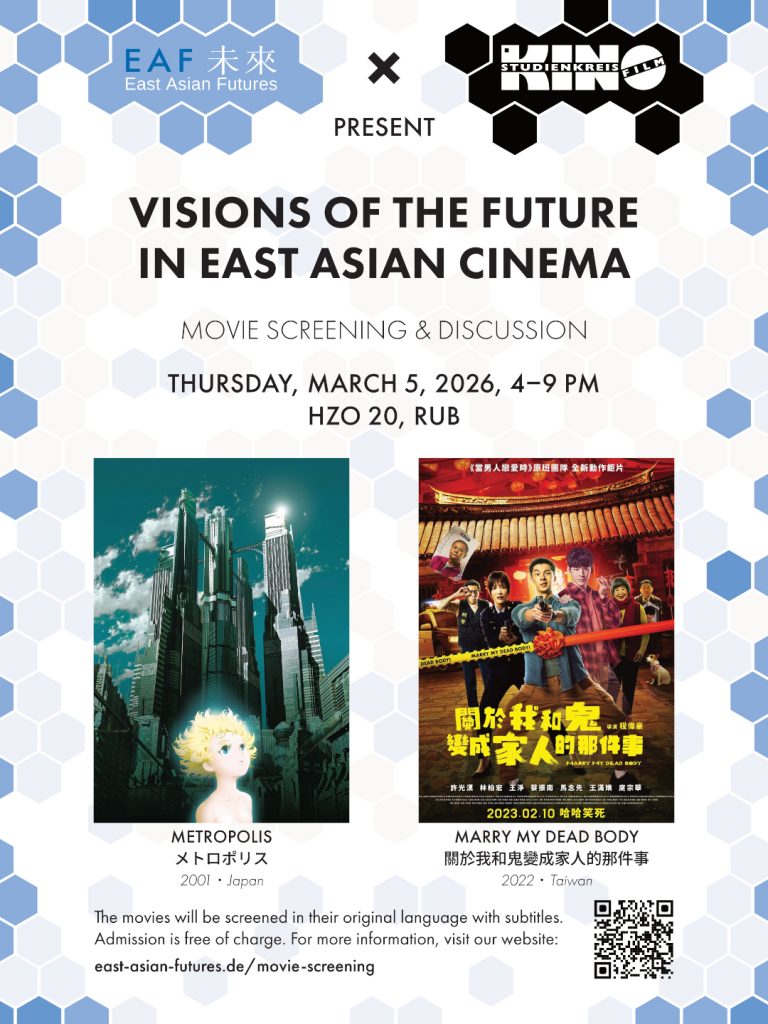
The Research Training Group GRK 2833 “East Asian Futures” is happy to present our public outreach event “Visions of the Future in East Asian Cinema.” Across two afternoons in March, we explored cinematic visions of the future from Japan, Taiwan, South Korea, and China. The selected films engaged with questions of technology, society, apocalypse, memory, and imagination. Each screening was introduced and contextualised by our PhD researchers and Qualifying Fellows, followed by a discussion. As a public outreach event,it was open to everyone, and admission was free of charge. Three of the four movies were screened in their original language with English subtitles. Only the Korean movie was shown with subtitles in German.
On March 5, 2026, 4–9 PM, we screened the Japanese anime film Metropolis (2001) and the Taiwanese genre-bending comedy Marry My Dead Body (2022). This screening took place in cooperation with the Studienkreis Film (SKF) at Ruhr University Bochum in lecture hall HZO 20.
On March 18, 2026, 4–9 PM, we did present the South Korean science fiction anthology Doomsday Book (2012) and the Chinese sci-fi comedy Moon Man (2022). This second event was organised in cooperation with the local cinema Endstation Kino (Wallbaumweg 108, 44894 Bochum).
We would like to extend our sincere thanks to both of our cooperation partners! Without their help, our public outreach event would not have been possible, and we are very grateful for their support.
The GRK organising team deserves great praise for the events. Isabelle Koldewitz, a student assistant majoring in Chinese Studies and Media Studies, carefully organised and executed every step of the process—from the screenings in the cinema and lecture hall to the blog posts—with the support of administrative coordinator Jonas Sohrweide, who organised the screening facilities and licences, and IT administrator Jan Wiemann, who designed the posters for the event and the blog websites.
General Information about Metropolis: Robotic Angel
Genre
Anime film
Title
メトロポリス
Translated title
Literally: Metropolis
Officially: Metropolis: Robotic Angel
Release date
2001
Directed by
Rintarō りんたろう
Screenplay by
ŌTOMO Katsuhiro 大友克洋
Based on
Metropolis by TEZUKA Osamu 手塚修
Producers
MARUYAMA Masao 丸山正雄
YAMAKI Iwao 八巻磐
Production company
Madhouse, Japan
Running time
113 minutes
Languages
Japanese
When we think about the future, we rarely do so in a vacuum. Our visions of what is to come are deeply rooted in our culture, our history, and the media we consume. This intersection of culture, technology, and imagination is exactly where the work of the Research Training Group GRK 2833 “East Asian Futures” at Ruhr University Bochum and University of Duisburg Essen resides, and it is precisely the space we explored during our recent movie events in March 2026. In this comprehensive blog entry, we provide a detailed look behind the scenes of our event, discuss the Japanese movie Metropolis: Robotic Angel (2001), and dive into the cinematic and societal discourses that shape our understanding of tomorrow. We hope this will be an inspiration for contemplating the broad subject of our future!
Introduction: Exploring East Asian Futures at the Ruhr University
Before we look at cinematic analysis and the world of robot ethics, let us introduce who we are, where this event took place, and why we chose this specific piece of media to represent our research.
The host of our event was the Ruhr-Universität Bochum (RUB). Since the GRK is co-hosted at two universities, we got the chance to use the Ruhr Universities cinema. Given RUB’s constant commitment to regional transformation for the last 60 years, it is quite a fitting venue to discuss the future (That’s basically a slogan that RUB has on its website). The university has almost 40,000 students and its own tram station at the main campus, and is, moreover, not rarely a host of events open to the public like ours.
A vital part of the cultural and student life at this campus is the Uni-Kino in the Room HZO 20 (the university cinema, known as the Studienkreis Film or SKF). For decades, the Uni-Kino has been a place where students, film enthusiasts, and researchers gather to experience the magic of cinema on the big screen and engage in critical discourse. They often collaborate with campus organisations, and thanks to their cooperation, we could also launch our public outreach event series, “Visions of the Future in East Asian Cinema”, here.
Behind this event stands the Research Training Group 2833: “East Asian Futures: Visions and Realizations on National, Transregional and Global Scales”—a joint research program uniting two major centers for East Asian Studies in North Rhine-Westphalia: the Faculty of East Asian Studies at the Ruhr-Universität Bochum and the Institute of East Asian Studies at the University of Duisburg-Essen (UDE). Led by our speakers, Prof. Dr. Christine Moll-Murata (RUB) and Prof. Dr. Markus Taube (UDE) and funded by the German Research Foundation (DFG), our Kolleg has been active since 2023.
We are a team of doctoral researchers and MA students aiming to open up a new field in East Asian area studies. We investigate how conceptions of the future are formed, negotiated, and realized in East Asia. By combining a macro-regional perspective with a strong focus on the modern and contemporary periods (from 1850 to the present day), we analyse the future projections of countries like Japan, China, Taiwan, and Korea in relation to one another and to the globe. These concepts of the future are applied to multiple fields like language, religion and ideology, self and society, resources and technology and sovereignty and governance.
As aspiring scientists, we view science communication as one of our central duties. Movies serve as a practical medium for this purpose, and while not everyone may understand the concept of governance or the theories of time, everyone has watched a movie before, right? Through cinema, we can transport our complex research to a broader audience, making abstract concepts of the future highly approachable and engaging.
To kick off our movie series, we selected the Japanese animated masterpiece Metropolis (Metoroporisu メトロポリス, released in 2001, and often subtitled “Robotic Angel”). But what does this movie have to do with our research?
The 2001 anime is a unique lens through which we can examine the layering of past future visions. It is based on a 1949 manga by the legendary Japanese artist Tezuka Osamu 手塚修 (1928–1989), which itself was loosely inspired by Fritz Lang’s iconic 1927 German silent film Metropolis. It was directed by Hayashi Shigeyuki with a screenplay written by Ōtomo Katsuhiro 大友克洋. By analyzing this film, we are essentially looking at the 21st century through the eyes of a Japanese artist in 1949, who was inspired by the anxieties of Weimar-era Germany in the 1920s. It illustrates how filmmakers and authors imagine the future of society where humans and robots coexist—or catastrophically fail to do so.
The film directly addresses the core questions of our Kolleg: How is the future constructed? Who do we imagine controls the technology of tomorrow? And, the movie also asks, “Are robots emotional beings? Can they nurture love?”, making us reflect on the so-called human condition and gives rise to a meaningful question: “What does it mean to be human/What makes us human?”
Through this transcultural journey from Germany to Japan and back to our cinematic screen in Bochum, we witness the evolution of future visions, exploring themes of artificial life, existential crises, and the limits of human hubris.
Metropolis – A Transcultural Evolution of the Future
To truly appreciate the depth of Metropolis: Robotic Angel, we must delve into its background, its creators, and the thematic shifts that occurred as the story evolved from a craze about a 1927 German silent film to a 1949 Japanese manga, and finally to a 2001 classic anime.
The 2001 film adaptation of Metropolis was a monumental undertaking in the anime industry, produced by Madhouse Studios and Toei Animation with conceptual support from Tezuka Productions.1 It brought together an all-star production team: The director, Rintarō (legal name Hayashi Shigeyuki 林重行), is a veteran of the industry who began his career working directly with Tezuka on classic 1960s television series like Astro Boy (Tetsuwan Atom) and Kimba the White Lion (Jungle Taitei). The screenplay was penned by Ōtomo Katsuhiro, a legendary figure in his own right, whose groundbreaking cyberpunk manga and film Akira revolutionized the genre and helped introduce anime to Western audiences in the 1980s. The film also features New Orleans-style jazz soundtrack composed by Honda Toshiyuki 本多俊之 which acts as a counterpoint to the dystopian visuals.
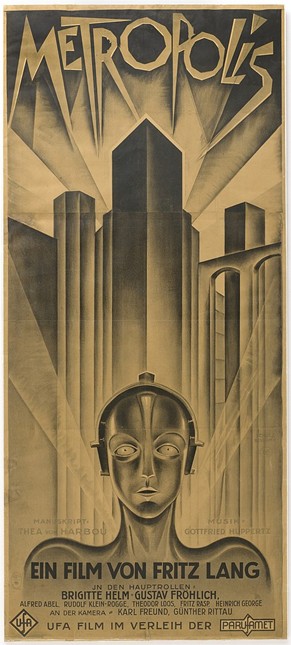
The foundation of the film itself, however, is the 160-page manga published in 1949 by Tezuka Osamu. Tezuka is universally revered as the “God of Manga” in Japan.2 His works deeply shaped modern Japanese pop culture and he inspired many famous artists like Miyazaki Hayao 宮崎駿 (Studio Ghibli e.g. Princess Mononoke). Tezuka’s original 1949 Metropolis manga was created under unique circumstances: he claimed to have only seen a single still image from Fritz Lang’s 1927 film on the advertisements that were going around when the film became famous in Japan.
The thematic evolution across the three versions of Metropolis from 1927, 1949, and 2001 offers a thoughtful look at how different eras and cultures process the anxieties of capitalism, class struggle (Klassenkampf), the treatment of robots, and the concept of the future.
Fritz Lang’s German Silent Film (1927): Lang’s Metropolis is deeply inscribed with the cultural and political anxieties of the Weimar Republic.3 The concept of the future here is an “architecture of control,” functioning as a totalitarian capitalist system where space is strictly compartmentalized: the elite ruling class thrives in the upper city (“pleasure gardens”), while the proletariat is banished to the subterranean depths.4 The Klassenkampf is the central driving force of the narrative in a totalitarian capitalist society.
In Lang’s vision, technology is a dehumanizing, mechanical nightmare. The workers are mere cogs in massive, rhythmic machines. The treatment of the robot is entirely malevolent: the inventor Rotwang creates a machine replica of the saintly worker Maria. This Robot Maria acts as an “anti-subject” or traitor designed to transmit false knowledge and incite the workers into a violent, self-destructive rebellion. The film ultimately resolves the class struggle not through revolution, but through a highly ambiguous, perhaps even reactionary, reconciliation between capital (the head) and labor (the hands), mediated by love (the heart). The robot is burned at the stake, returning to its true, terrifying mechanical form.5 This is interesting, since it shows an ethical dilemma of how people are “deceived” by a humanised machine they themselves created.

Tezuka’s manga from 1949 shifts the focus: Rather than centring on a strict Marxist class struggle between human workers and elites, this manga turns towards the existential plight of artificial life—a different consideration when thinking about robot ethics. In his version, humans and robots coexist, but the power dynamic is vastly unequal. A scientist named Dr. Laughton (or Dr. Bell) creates an advanced artificial being named Michi, who is gender-fluid and driven by synthetic cells and sunspots.
The “Klassenkampf” here is transformed into an insurgency of the artificial against the natural. When Michi discovers their own true nature—that they are not human, but a manufactured product owned by the powerful Duke Red—they experience a profound identity crisis. Enraged by the realization that they are viewed as mere property, Michi leads a robot revolt against humanity. Ken’ichi, the young protagonist, tries to stop the violence, resulting in a tragic battle where Michi is destroyed. However, unlike Lang’s film where the robot is purely evil, Tezuka evokes deep empathy for the machine. When the public learns why Michi revolted, their hatred turns to sorrow and understanding. Tezuka’s concept of the future warns against scientific hubris, questioning whether our creations will inevitably rise up if we fail to treat them with dignity.
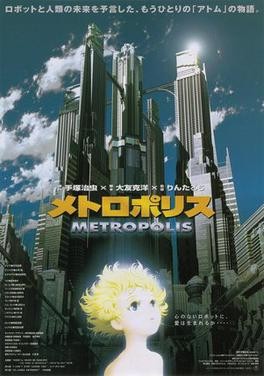
Rintaro and Otomo’s 2001 anime film Metropolis synthesizes Lang’s architectural class divide with Tezuka’s empathetic characters. The city of Metropolis is a marvel of 3D computer graphics blended with traditional 2D character animation, which has won international reviewers’ hearts. Here, the class struggle is multi-layered. Visible robots are heavily discriminated against, treated as second-class citizens, and forced to work in the deepest, most dangerous subterranean levels Zone Three. Simultaneously, human workers have been displaced by these robots, leading to violent, fascist insurgencies among the unemployed human underclass who direct their anger at the machines rather than the elite.
The treatment of robots is explored with profound nuance. We meet FiFi, a discarded garbage robot who shows immense care for Ken’ichi and the human looking android girl Tima, sacrificing itself to save them. Tima, modelled after Duke Red’s deceased daughter, is the ultimate technological achievement, designed to integrate with the Ziggurat—a massive tower meant to secure Duke Red’s god-like dominion over the earth. Duke Red views Tima purely as a machine, telling her she is “no mere human being … ruled by emotion and feeling”. But Ken’ichi treats her with affection, teaching her language and empathy. When Tima’s robotic nature is revealed by Red’s jealous adopted human son who has an aversion to robots, her confusion and emerging human emotions clash with her programming. The result is an apocalyptic breakdown. The film suggests that the true danger of the future is not technology itself, but humanity’s inability to overcome its own flawed emotions—jealousy, greed, and a lack of empathy.
Robot: «Why must humanity settle matters by resorting to violence?»
Insurgent: «Yes, we all know that. I agree it’s a problem. It’s our emotions. They vibrate, and all we can do … is move forward within that amplitude.»
(Insurgent raises a gun and blows the robot’s head off. Riot starts.)
[…]
Tima: «You have to tell me if I’m a human or not. Please tell me, am I really just another machine like those poor robots.»
Duke Red: «Oh Tima, what a silly thing for you to say. I promise that you are nothing like those pathetic robots.»
Tima: «Then I am human. Same as Ken’ichi. There’s no difference»
Duke Red: «What are you talking about?! You are no mere human. Humans are inferior creatures, confused by love and morality, ruled by emotions.»6
Perceptions of Robots in East Asia and in the West
The differing portrayals of robots in these three works lead us to a broader discussion about how the future of robotics is envisioned in East Asia compared to the West.
In the West, cultural narratives often suffer from the “Frankenstein complex” or the “uncanny valley”.7 From the very coinage of the word “robot” in Karel Capek’s 1920 Czech play R.U.R. (derived from robota, meaning forced labor or slave), Western fiction frequently portrays artificial beings as a threat that will inevitably rebel and destroy their masters.8 Fritz Lang’s evil Robot Maria is a prime example of this anxiety.9
In contrast, Japan has historically exhibited a much higher social acceptance of robots. Japanese dictionaries define robots not inherently as slaves, but as precision mechanisms or artificial humans. Scholars often point to the influence of Shinto and animism, which posits that a spiritual essence (kami) can reside in both animate and inanimate objects.10 Tezuka Osamu’s post-war creation Astro Boy cemented the idea of the robot as a friendly, heroic companion—a savior rather than a destroyer.
Today, as Japan faces a rapidly aging population and a severe labour shortage, the government and society actively envision a future where robots integrate seamlessly into daily life to provide care and assistance.11 However, this vision is not without its ethical flaws. Anthropologist Jennifer Robertson highlights the phenomenon of “robo-sexism” in modern Japan. She notes that rather than integrating human immigrants to solve labor shortages, Japan pours billions into developing humanoid robots. Furthermore, these robots are often highly gendered to reinforce traditional, conservative societal roles—such as female androids designed specifically to serve as submissive receptionists or caregivers, seemingly freeing human women to return to domestic duties.12
Interestingly, modern psychological studies show that while cultural narratives differ, fundamental human moral judgments regarding robots might be more universal than we think. Research comparing U.S. and Japanese participants facing moral dilemmas involving robots found that both cultures heavily blame robots that fail to intervene to save human lives. This suggests that while Japan may enthusiastically embrace the aesthetic and functional presence of robots, the ethical demands placed upon autonomous machines remain stringently high across the globe.13
Metropolis (2001) captures this exact tension. It presents a society that relies entirely on advanced machinery yet systematically degrades the artificial beings that sustain it. When a rebel human shoots a robot, he acknowledges the tragedy, noting that human emotions “vibrate, and all we can do … is move forward within that amplitude” before resorting to violence. Tezuka’s 1949 warning remains incredibly relevant today: a highly advanced technological future is useless, and ultimately destructive, if it is not matched by an equally advanced sense of human morality and empathy. At this juncture, we can again recognise the key areas of our research, which are represented in the movie.
Language, Religion, and Ideology are all clearly deep concepts in the movies that deserve more than a passing glance: The 2001 film’s central architectural set piece, the Ziggurat, explicitly references the biblical Tower of Babel. It is an ideological monument to human hubris and the desire of the elite (Duke Red) to equate themselves with gods through technological supremacy. Robot ethics also play into this dilemma and are mingled in all three of these areas.
Self and Society can be found in Tima’s story, as it is a profound exploration of identity. Her existential crisis—asking “Am I human?”—and her ultimate malfunction when she discovers her synthetic reality, challenges the boundaries of personhood and societal belonging.
Resources and Technology are areas which are central to the film, apparently more so than to Japanese society itself, if one believes Professor Jennifer Robertson. The film portrays a dystopia where robots are heavily exploited as a labour resource, relegated to the toxic underground zones. It serves as a critique of how technological advancement under unchecked capitalism leads to the marginalization of both human and artificial labourers. The dangers of technological development and how the view on them changes can be viewed very well through the lense of these three pieces of media.
Sovereignty and Governance can be seen in Duke Red’s extreme manipulation of politics, military force, and scientific research to achieve total global hegemony illustrates the terrifying potential of authoritarian governance in a hyper-technological future.
Review of the Viewing Event: Engaging the Public
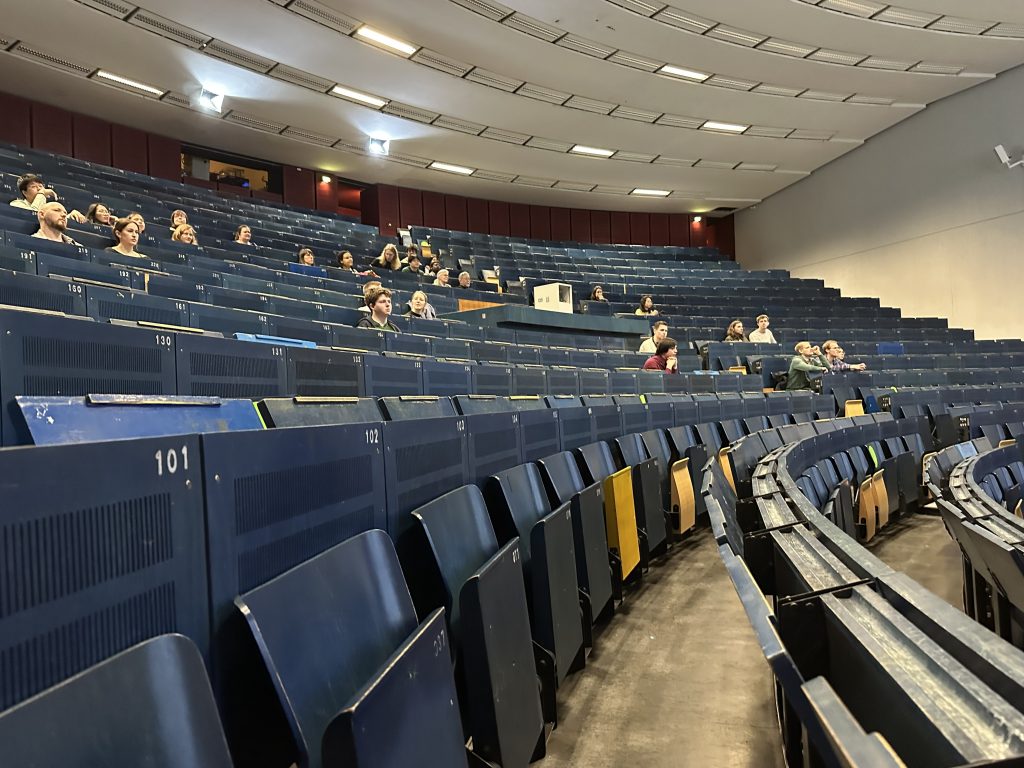
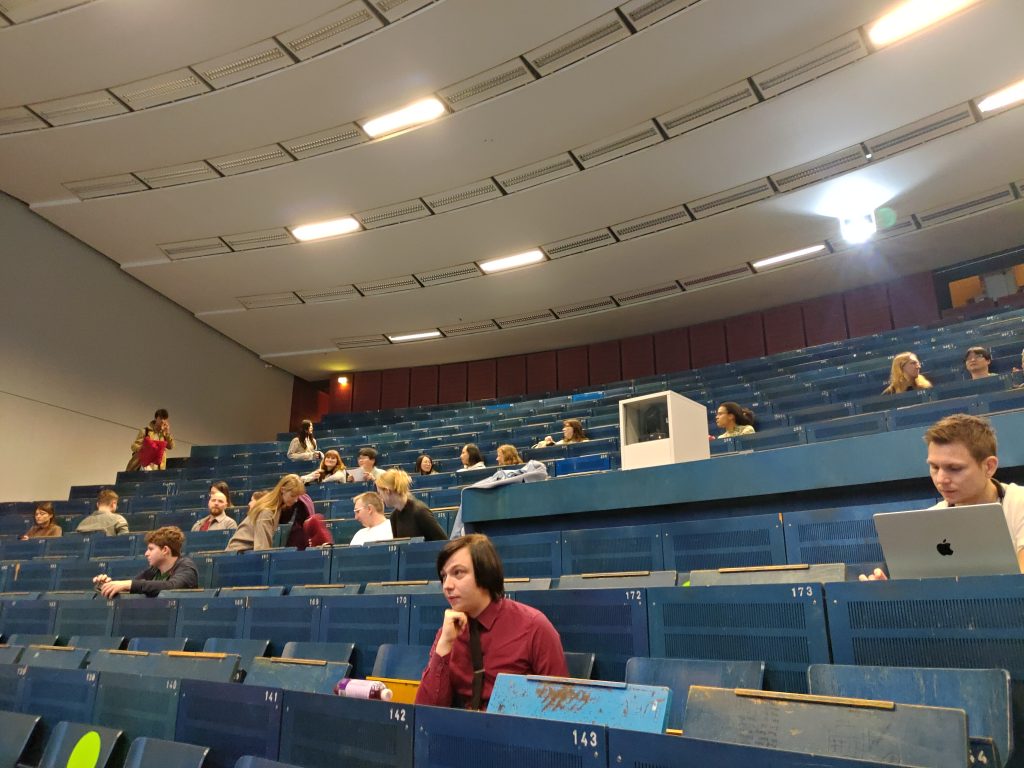
On March 5, 2026, the event focused on future visions in movies from Japan and Taiwan, and we were thrilled to see an engaged and diverse audience join us in the lecture hall.
How did it go? We presented a short introduction, setting the stage by explaining the background of the GRK and contextualizing Tezuka’s original 1949 manga against the 2001 film adaptation, before actually getting to watch the movie
The audience was deeply captivated by the film. Viewers were particularly struck by the sheer visual spectacle of the movie.
What makes this event so special is the power of the medium. As researchers, we often deal with dense texts and abstract theories. But through cinema, we are able to transport our research directly to the public. Metropolis (2001) allowed us to make the abstract concepts of “East Asian Futures” tangible, emotional, and visually graspable. It proved that the questions we are asking in our Kolleg today—about history, technology, ethics, and the trajectory of human society—are not just academic exercises; they are cultural conversations that have been evolving for nearly a century and that filmmakers, researchers and the general public all participate in.
We are very grateful to everyone who attended and participated. We look forward to continuing this journey and our exploration of various visions of the future.
… To the future and beyond!
- Robotic Angel 2001. ↩︎
- Ito 2008. ↩︎
- Williams 1974. ↩︎
- Pješivac 2015. ↩︎
- Williams 1974. ↩︎
- Syversen 2019. ↩︎
- Rausch 2021. ↩︎
- Kitano 2005. ↩︎
- Huyssen 1981/1982. ↩︎
- Robertson 2010. ↩︎
- Kitano 2005. ↩︎
- Robertson 2010. ↩︎
- Komatsu / Malle / Scheutz 2021. ↩︎
References
- Huyssen, Andreas, “The Vamp and the Machine: Technology and Sexuality in Fritz Lang’s Metropolis”, New German Critique, 24/25, 1981/1982, Special Double Issue on New German Cinema, 221-237, https://scalar.usc.edu/works/usm-open-source-history-text-the-world-at-war-world-history-1914-1945/media/488052.pdf.
- Ito, Kinko, “Manga in Japanese History”, in Japanese Visual Culture: Explorations in the World of Manga and Anime Japanese Visual Culture, ed. by Mark W. MacWilliams. New York: Routledge 2008, 26-47.
- Kitano Naho, “Roboethics – a comparative analysis of social acceptance of robots between the West and Japan”, The Waseda Journal of Social Sciences, 6, 1-12, 2005 http://www.roboethics.org/atelier2006/docs/Kitano%20west%20japan.pdf.
- Komatsu, Takanori / Malle, Bertram F. / Scheutz, Matthias, “Blaming the Reluctant Robot: Parallel Blame Judgments for Robots in Moral Dilemmas across U.S. and Japan”, HRI ’21, 2021, Boulder, CO, USA, https://hrilab.tufts.edu/publications/komatsuetal21.pdf.
- Pješivac, Željka, “Spaces of Territorialization in Fritz Lang’s Film Metropolis (1927)”, AM Journal of Art and Media Studies, (7), 85–95. https://doi.org/10.25038/am.v0i7.93.
- Rausch, Katja, “The ‘uncanny valley’ in robotics?”, The House of Ethics 2021, https://www.houseofethics.lu/2021/04/17/the-uncanny-valley-in-the-robotics/.
- Robertson, Jennifer, “Gendering Humanoid Robots: Robo-Sexism in Japan”, Body & Society 16/2, 2010, 1–36; DOI: 10.1177/1357034X10364767.
“Robotic Angel” Press Release / Website by Polyfilm Verleih, Vienna, 2001, https://archiv.polyfilm.at/robotic_angel/robotic_poly.pdf. - Syversen, Robin, “Metropolis: Anime Review & Analysis. Looking Between the Layers of Metropolis”, Japanese Cinema Archives Blog 2019, https://www.jcablog.com/post/metropolis-review.
- Williams, Allan, “Structures of Narrativity in Fritz Lang’s Metropolis”, Film Quarterly 27/4, (Summer, 1974), 17-24, https://www.jstor.org/stable/1211391.
Illustrations
- Image 1: https://www.moma.org/collection/works/88251
- Image 2: https://en.wikipedia.org/wiki/Metropolis_%28manga%29#/media/File:Metropolis_manga_(1979_reprint).jpg
- Image 3: https://en.wikipedia.org/wiki/Metropolis_(2001_film)#/media/File:Metropolisanime_poster.jpg
- Image 4: Photograph by S. Kortung
- Image 5: Photograph by C. Moll-Murata
.jpg)
#/media/File:Metropolisanime_poster.jpg)