By HUANG Pao-Wen, WU Ming-Feng, Lea WALLRAFF
The Public Outreach Event
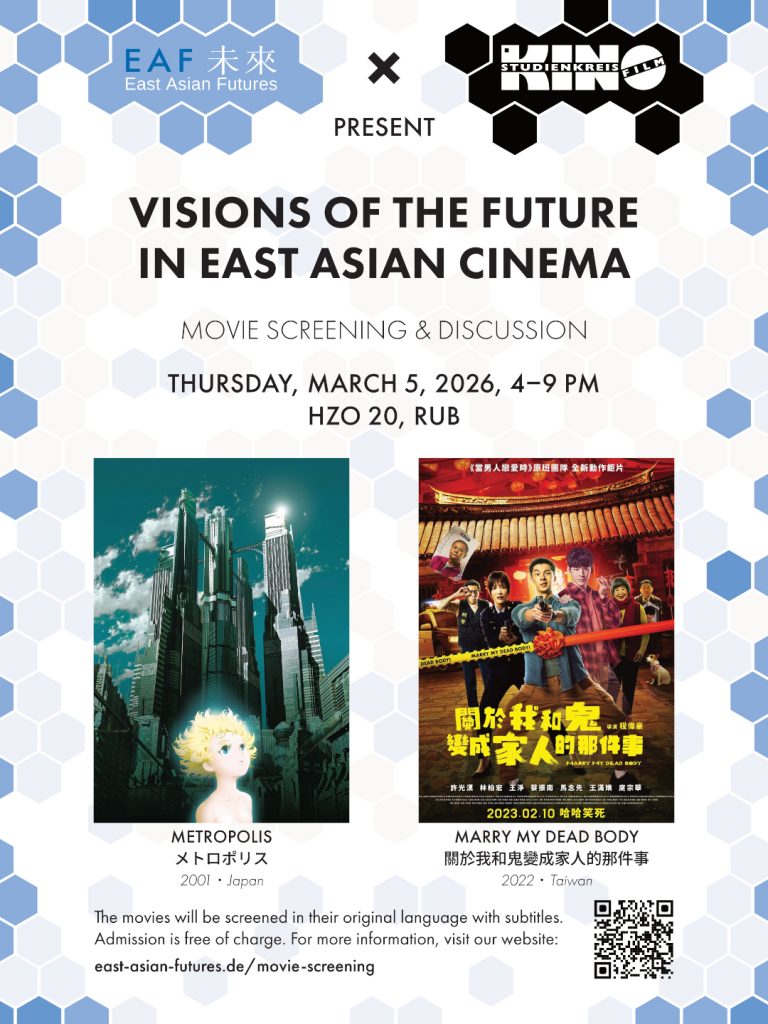
The Research Training Group GRK 2833 “East Asian Futures” is happy to present its public outreach event “Visions of the Future in East Asian Cinema.” Across two afternoons in March, we explored cinematic visions of the future from Japan, Taiwan, South Korea, and China. The selected films engaged with questions of technology, society, apocalypse, memory, and imagination. Each screening was introduced and contextualised by our PhD researchers and Qualifying Fellows, followed by a discussion. As a public outreach event, it was open to everyone, and admission was free of charge. Three of the four movies were screened in their original language with English subtitles. Only the Korean movie was shown with subtitles in German.
On March 5, 2026, 4–9 PM, we screened the Japanese anime film Metropolis (2001) and the Taiwanese genre-bending comedy Marry My Dead Body (2022). This screening took place in cooperation with the Studienkreis Film (SKF) at Ruhr University Bochum in lecture hall HZO 20.
On March 18, 2026, 4–9 PM, we presented the South Korean science fiction anthology Doomsday Book (2012) and the Chinese sci-fi comedy Moon Man (2022). This second event was organised in cooperation with the local cinema Endstation Kino (Wallbaumweg 108, 44894 Bochum).
We would like to extend our sincere thanks to both of our cooperation partners! Without their help, our public outreach event would not have been possible, and we are very grateful for their support.
The GRK organising team deserves great praise for the events. Isabelle Koldewitz, a student assistant majoring in Chinese Studies and Media Studies, carefully organised and executed every step of the process—from the screenings in the cinema and lecture hall to the blog posts—with the support of administrative coordinator Jonas Sohrweide, who organised the screening facilities and licences, and IT administrator Jan Wiemann, who designed the posters for the event and the blog websites.
General Information about Marry My Dead Body
Genre
Comedy mystery film
Title
關於我和鬼變成家人的那件事
Translated title
Literally: About the incident when I became family with a ghost
Officially: Marry My Dead Body
Release date
2022
Directed by
CHENG Wei-hao 程偉豪
Screenplay by
CHENG Wei-hao 程偉豪
Sharon WU 吳瑾蓉
Based on
Story by LAI Chih-liang 賴致良
Producers
Veronica JIN 金百倫
Dennis WU 吳明憲
Production company
Calendar Studios, Taiwan
Running time
130 minutes
Languages
Mandarin Chinese
Taiwanese Hokkien
Introduction
In contrast to the other films discussed in this blog series, “Marry My Dead Body” can hardly be fitted into the category of science fiction. The characters, backgrounds, and topics all seem decidedly contemporary, and folk religion definitely plays a larger role than technology. Nevertheless, it can just as easily be related to the topic of the future since it addresses questions of modernization, social harmony, and spirituality. More precisely, it is a story about a society still trying to reconcile traditional culture with new expectations for the future by offering more pragmatic solutions than abstract predictions. It also negotiates different temporalities of marriage, life, and death to define a new social order centered on emotional repair. The future is the state of progress achieved only after the emotional scars of the past are mended.
The film we chose for the RTG film screening is called “Marry my dead body” in English and “Guanyu wo he gui biancheng jiaren de na jian shi” 關於我和鬼變成家人的那件事 in Chinese. This title can be translated roughly as “How I became family with a ghost.” The film was directed by Cheng Wei-hao 程偉豪 and stars a couple of well-known Taiwanese actors. After its debut at the Golden Horse Festival in 2022, it performed well at the Taiwanese box office and received mostly favourable reviews. The fact that the film was shown on Netflix also contributed to its popularity outside Taiwan, especially among the Chinese-speaking diaspora, and beyond. It might be surmised that its quick pace and humour, as well as the specifically Taiwanese (and in some respects, East Asian) mix of topics addressed in the film contributed to this success, and we will discuss some of these in this post.
“Marry My Dead Body” tells the story of a police officer, Wu Ming-han 吳明翰, who is openly homophobic. Unexpectedly, he becomes involved in a posthumous marriage with the spirit of a gay man, called Mao-mao 毛毛. While it is not surprising that both men struggle with this arrangement, their relationship gradually improves during the course of the story. To send Mao- mao’s spirit to his next life, Wu Ming-han must help him uncover the truth about his death and fulfill his last wish. As he realizes that Mao-mao’s death is also related to a criminal case that he is working to solve, the film increasingly takes on the features of a police thriller.
Even a cursory look at the storyline makes it clear that this film can only be described as a blend of different genres. While seriously scary ghost movies have a long tradition in East and Southeast Asia, this film is not a horror movie, but only plays with some scary tropes of this genre to create humour. It is certainly closer to a comedy, focusing mostly on the pitfalls of the relationship between a homophobic policeman and a gay ghost. Nevertheless, crime and policework, full of action, also take up a considerable part of the film. Additionally, the film manages to negotiate complex issues like generational conflicts or the balancing of tradition and recent cultural changes.
Some of these issues arise from the plot’s specifically Taiwanese background and shall be discussed in the following. The focus shall lie on temporalities of life and death, the political background (i. e., the legalization of same sex marriage) and the traditional custom of ghost marriage.
Temporalities of Life and Death
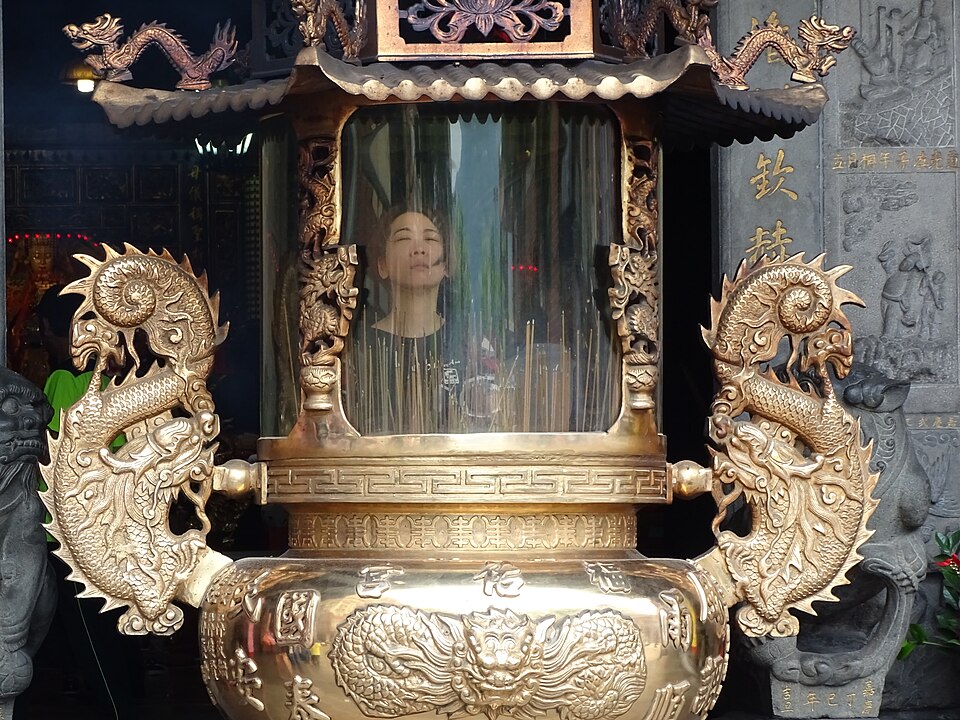
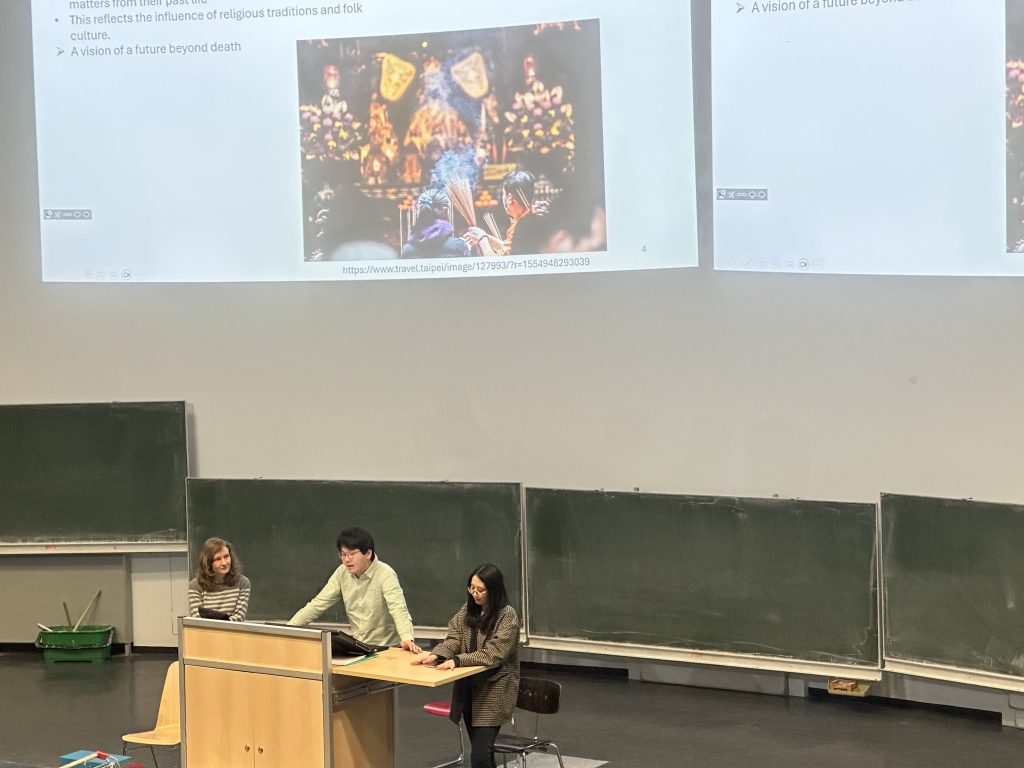
To understand this film, it is important first to understand some key ideas in Taiwanese culture, especially ideas about life, death, and the next life. In Taiwan, death is usually not seen as the end of existence. Many people believe that after death, a person moves on to another life. This belief is not confined to the formally religious. A 2024 Pew Research survey found that 87 percent of Taiwanese adults believe in karma, the idea that actions in this life shape the conditions of the next. 85 percent believe in unseen beings such as deities or spirits.1 These numbers hold even among people who identify with no religion.
The belief in ghosts follows from this logic. If life is cyclical, then some deaths are incomplete. A person who dies carrying strong regret, injustice, or unfinished matters may not move forward. Therefore, they remain bound to the living world, unable to pass on.
This matters in how Taiwanese culture understands time. Life is not a straight line from birth to death. Itis a cycle. The “future” does not belong only to the living. It extends beyond death, into the next life and the one after that. Karma structures this future. Good deeds accumulate. Wrong persists. Ghosts are not simply frightening figures. They are tragic ones. The weight of unfulfilled desires keeps them here. This is why Taiwanese ghost stories are rarely just about fear. They are about unresolved time. A past that refuses to become past. A future that has not yet been allowed to begin.
Political Background
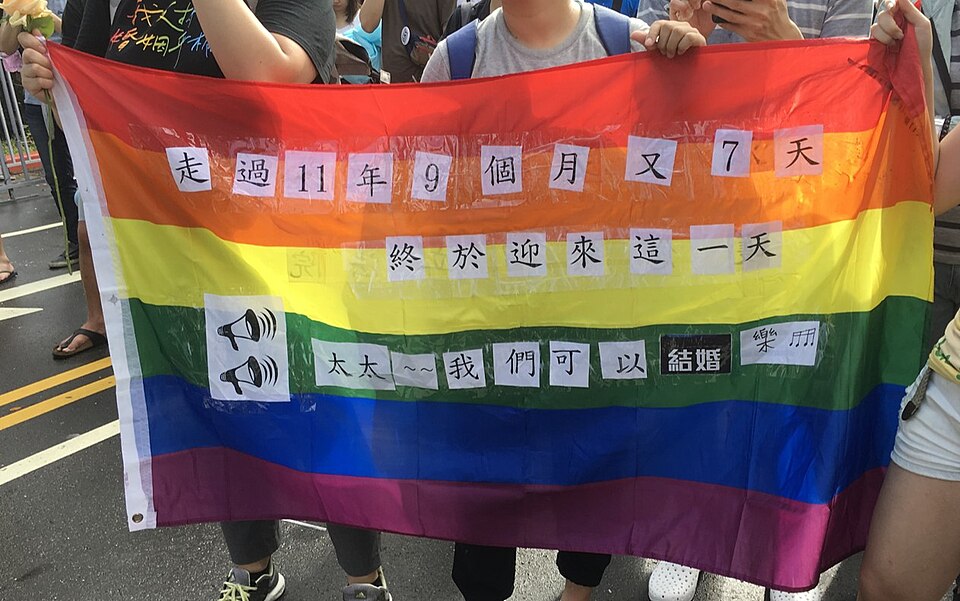
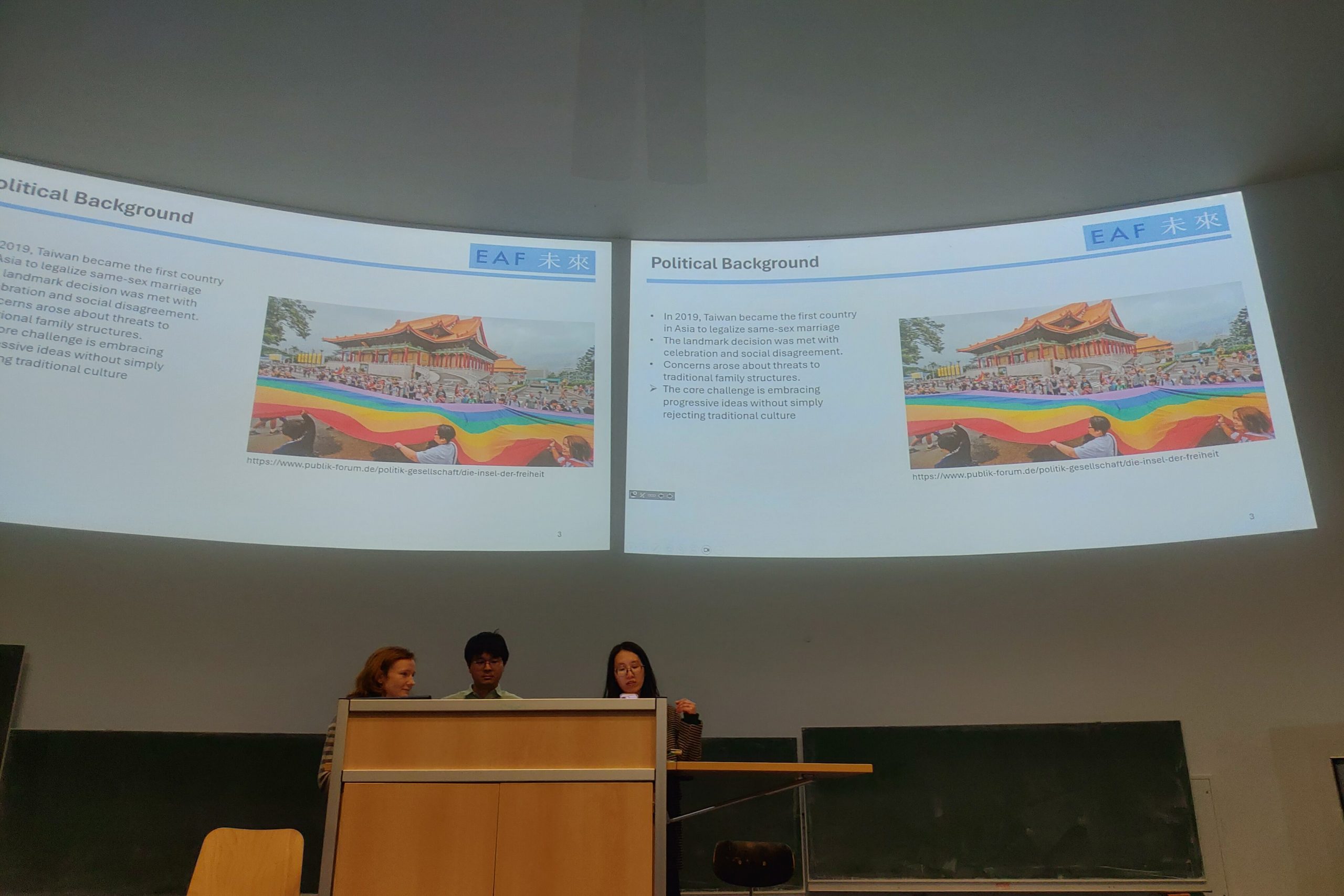
In 2019, Taiwan became the first country in Asia to legalize same-sex marriage. While this was widely applauded by Western countries as a courageous step towards social equality and “progress,” the Same-Sex Marriage Act was not passed without substantive opposition from parts of Taiwanese society. Most notably, a referendum and accompanying campaign initiated by anti-LGBTQI+ groups led to a more heated political climate and backlash against the equality movement. Competing visions of family stood at the center of these debates: Some anti-gay groups argued that legalizing same-sex marriage would destroy the traditional family structure. Apart from concerns that birth rates would sink further if same sex marriage were legalized, the whole institution of family is seen as under attack, since it is also based on fixed gender roles. Thus, even after the law was passed, many same-sex couples chose not to marry, not because they rejected the law, but because they were afraid of hurting their families or being rejected by them.2 At the core of these fears is a very traditional idea of family: one man, one woman, marriage, and children. For many people, this structure is closely tied to social order, moral values, and ideas about the paths that personal futures can take.
This film was released in 2023, four years after same-sex marriage became legal. Yet it shows that embracing progressive ideas without simply rejecting traditional culture is still an ongoing challenge in Taiwanese society.3 It asks an important question: How can we imagine a future that includes everyone while still living under the influence of long-standing cultural traditions and in a rapidly developing global society?
The movie mirrors the complex situation surrounding the acceptance of marriage equality in Taiwan: Mao-mao’s grandmother argues that, since same sex marriage is already legalized in this world, it should also be possible to adapt the custom of ghost marriage accordingly – thus tradition and contemporary social movements are shown as compatible and not necessarily contradictory. On the other hand, Wu Ming-han’s homophobia, especially at the beginning of the movie, also points out the gap between legislative decisions and social reality. Even though many of the social issues arising from the same sex marriage debate are not verbally discussed in the movie, they are still addressed in the plot, such as the stress that is put on Mao-mao’s family relations due to his father’s and his own differing opinions.
However, the film is also quick to offer its own solutions to some of these issues. Through his close contact with Mao-mao and insight into his world and the challenges he faced every day, Wu Ming-han not only overcomes his homophobia and begins supporting LGBTQI+ rights, but also develops a close friendship (though not a romantic relationship!) with the ghost. They become inseparable partners, take on the role of “parents” for Mao-mao’s dog, and even sacrifice themselves for the other’s sake. And even after Mao-mao passes on to the next world, Wu Ming-han sustains a close relationship with his in-laws, having effectively become part of the family. The Chinese title gives another clue pointing in the same direction: instead of being about marrying a ghost, which would have been the obvious choice, it runs “How I became family with a ghost.” Wu Ming-han’s relationship with Mao-mao and his relatives is thus not only a story about friendship but also a proposition for alternative family models that accommodate not only romantic same-sex relationships but also other kinds of partnerships. The movie advocates for a future society that could be made more harmonious by being more empathetic and more tolerant of our fellow human beings.
Posthumous Marriage
Based on the beliefs of the afterlife, the tradition of posthumous marriage, also known as “ghost marriage” (minghun 冥婚), developed in Taiwanese society. Although many people today view it as superstition, it was once taken very seriously.
In the past, dying without getting married was considered a major problem. Marriage was seen as a necessary part of a “complete” life. If a person died unmarried, it meant there would be no descendants to carry on ancestor worship (jisi 祭祀). People feared that without proper worship, the dead would become lonely wandering spirits.
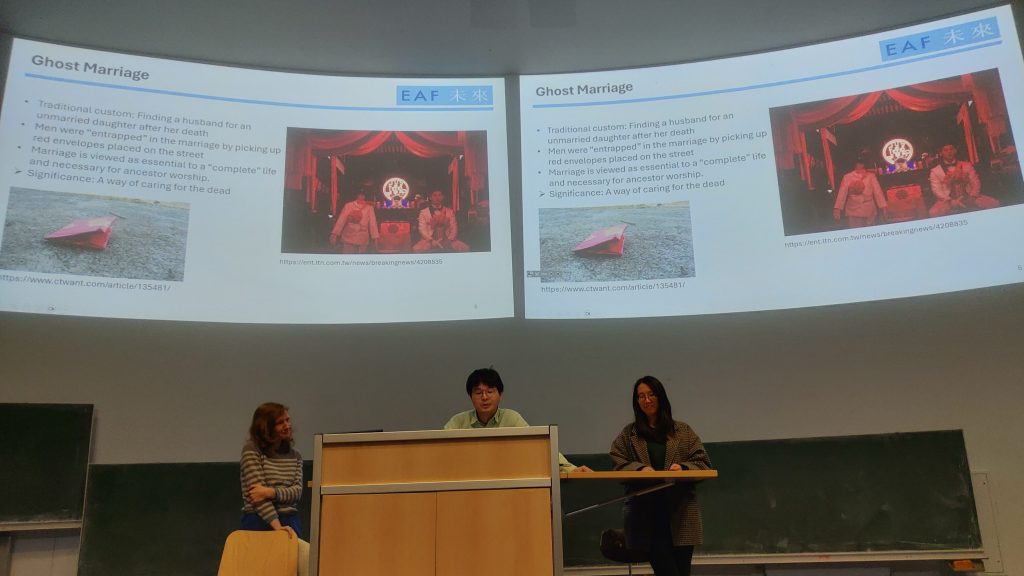
Because of this fear, families sometimes arranged posthumous marriages for young people who died unmarried. In some cases, if a young woman died before marriage, her family would place her hair or fingernails, along with her birth information, into a red envelope and leave it on the street. If a man picked it up, a posthumous marriage was considered to be formed. This traditional concern with family continuity and the afterlife connects closely to another important issue in the film: the future after same-sex marriage was legalized in Taiwan.
The ritual of posthumous marriage in Taiwan comes from Han Chinese culture. This is because a large part of Taiwan’s population is descended from Han Chinese people. Indigenous peoples in Taiwan do not practice this.4 In Han Chinese culture, it can be traced back to the Zhou Dynasty (c. 1046–256 BC). The Rites of Zhou (周禮, Zhouli), a Confucian text that describes an ideal political system from the Warring States period (475–221 BC), states that posthumous marriage should be forbidden. This suggests that the practice already existed before the Zhou Dynasty. There is also a well-known example in ancient China. The politician Cao Cao (曹操, 155–220) arranged a posthumous marriage for his son, who died young without marrying.5
Outside Han Chinese culture, many regions also have this practice. For example, in Japan, some areas practice posthumous marriage. In Aomori (青森), people arrange posthumous marriages to comfort the dead and make sure they are not alone in the afterlife. The partner does not need to be a real person. Sometimes a doll is used. It is more like a symbolic act. In Yamagata (山形), people also arrange posthumous marriages, but for a different purpose. It is seen as a way to complete the life of the deceased. People may ask a spirit medium who the dead person wants to marry and what this person looks like. In this case, the partner is treated more like a specific individual. In Okinawa (沖縄), people believe that couples continue to live together in the afterlife. Because of this belief, it is better to bury them together. This is done even if they were only engaged or in a relationship.6
Posthumous marriage is not limited to East Asia. It also appeared in some European countries. In Nazi Germany, it was called “Leichentrauung” or “nachträgliche Eheschließung”. During wartime, since many German soldiers died, some Nazi officials claimed that to preserve pure German blood for a better future, women should be encouraged to give birth to children with German soldiers. However, many soldiers died before marrying their fiancées, leaving these women as mothers of what were considered “illegitimate” children. Because many rights and the status of children depended on whether they were born in or out of wedlock, the Nazi government amended the law to allow these women to marry their deceased husbands.7
Similarly, in France, posthumous marriage was first used for the fiancées of dead soldiers. It helped protect the rights of their children. This practice became official after a tragedy in 1959. A dam collapsed, and more than 400 people died. A young woman lost her fiancé in this disaster. She was pregnant at that time. She worked hard to ask the government for help. Because of her efforts, France approved posthumous marriage. This made it possible to marry even if one partner had died suddenly. Even today, dozens of people apply for posthumous marriage in France each year.8
Although posthumous marriage exists in many regions, its meaning differs across cultures. These differences reflect distinct cultural values and views of the future. In East Asia, posthumous marriage is primarily associated with religious beliefs about the afterlife. It provides emotional comfort and reflects ideas about family continuity. In contrast, in Western countries, the practice is more closely connected to legal systems. In Germany and France, the focus is on legal rights and social status in the present. In Nazi Germany, it was even used as part of state policy. These differences reflect distinct cultural values and views of the future.
Conclusion
These different aspects, political, spiritual, and social, form the unique background of this movie, and are combined to propose a possible path towards a more harmonious future for Taiwan’s society. Instead of subscribing to an uncompromising social progressivism that disregards the consequences, “Marry My Dead Body” aims to reconcile traditional and “modern” ideals of co-existence in the hope of one day assuaging present conflicts. The film’s vision of the future operates across three registers at once: the karmic future of the dead, who must resolve their unfinished lives before passing on; the personal future of the living, who must repair their prejudices before forming new bonds; and the social future of Taiwan, still negotiating the terms of coexistence between tradition and change. All three follow the same logic, already embedded in the film’s spiritual worldview. Karma does not reset at death. The future cannot begin until the past is properly addressed. The future, in this film, is not a destination to be legislated into existence. It is the state of progress achieved only after the emotional brokenness of the past is mended, one relationship at a time.
- Pew Research Center 2024. ↩︎
- Lu 2020. ↩︎
- “Towards a More Equal Equality” 2024. ↩︎
- “Minghun yu Guniangmiao”. For detailed information, see Hsu Yu-Yin 2024, 3:58-27:00. ↩︎
- Ma Zhisu 1976. ↩︎
- Takamatsu 1994. ↩︎
- Essner / Conte 1996. ↩︎
- Patowary 2021. ↩︎
References
- Essner, Cornelia / Conte, Edouard, “Fernehe, Leichentrauung und Totenscheidung. Metamorphosen des Eherechts im Dritten Reich”, Vierteljahrshefte für Zeitgeschichte, 44/2 (1996), 201-227.
- Hsu Yu-Yin, “Ghost Marriage and Birth Customs in Taiwan”, lecture in the series “Taiwan in Geschichte und Gegenwart”, Ruhr University Bochum, April 22, 2024, https://easydb.uni-trier.de/collection/c4cc4b06-e681-445e-8fa6-f381d09e2059?collection=3b625bf7-c1c3-4462-863b-637087f7dc2f (Presentation 5).
- Lu, Jennifer, “Shifting Public Opinion in Different Cultural Contexts: Marriage Equality in Taiwan”, Georgetown Journal of International Affairs 21 (2020): 209–15. https://www.jstor.org/stable/27088161.
- Ma Zhisu 馬之驌, “Woguo gujin minghun xisu” 我國古今冥婚習俗 (Ghost Marriage in China), Shihuo yuekan 6/6 (1976), 241-247.
- “Minghun yu Guniangmiao” 冥婚與姑娘廟 (Ghost Marriage and the Maiden Temple), ASCDC Digital Archive, https://ascdc.digitalarchives.tw/subject_2179.html.
- Patowary, Kaushik, “How a Failed Dam Legalized Marrying The Dead”, Amusing Planet, 12 March 2021, https://www.amusingplanet.com/2021/03/how-failed-dam-legalized-marrying-dead.html.
- Pew Research Center, “Religion and Spirituality in East Asian Societies. Beliefs section.” 2024, June 17, https://www.pewresearch.org/religion/2024/06/17/beliefs/.
- Takamatsu Keikichi 高松敬吉, “Shigo kekkon: Nihon, Kankoku, Chūgoku no hikaku kenkyū” (死後結婚: 日本・韓国・中国の比較研究 Posthumous Marriage: A Comparative Study of Japan, Korea, and China), Hikaku minzoku kenkyū 比較民俗研究 (Comparative Folklore Studies), 10 (1994), 16-35.
- “Towards a More Equal Equality: LGBTQ+ Rights in Taiwan’s Post-2019 Political Landscape.” Global Taiwan Institute, June 2024. https://globaltaiwan.org/2024/06/towards-a-more-equal-equality-lgbtq-rights-in-taiwans-post-2019-political-landscape/
Illustrations
- Image 1: Photograph by S. Kortung
- Image 2: Photograph by Adam Jones (https://flickr.com/photos/41000732@N04/47827575242), CC BY 2.0
- Image 3: Photograph by 葉又嘉, (https://commons.wikimedia.org/wiki/File:台灣同婚法案jpg), CC BY-SA 4.0
- Image 4: Photograph by C. Moll-Murata
- Image 5: Photograph by C. Moll-Murata
