By Aman VERMA, Eetu LAUSTELA, Minkyun PARK, Seoyeon HAN, Youlim KIM
The Public Outreach Event
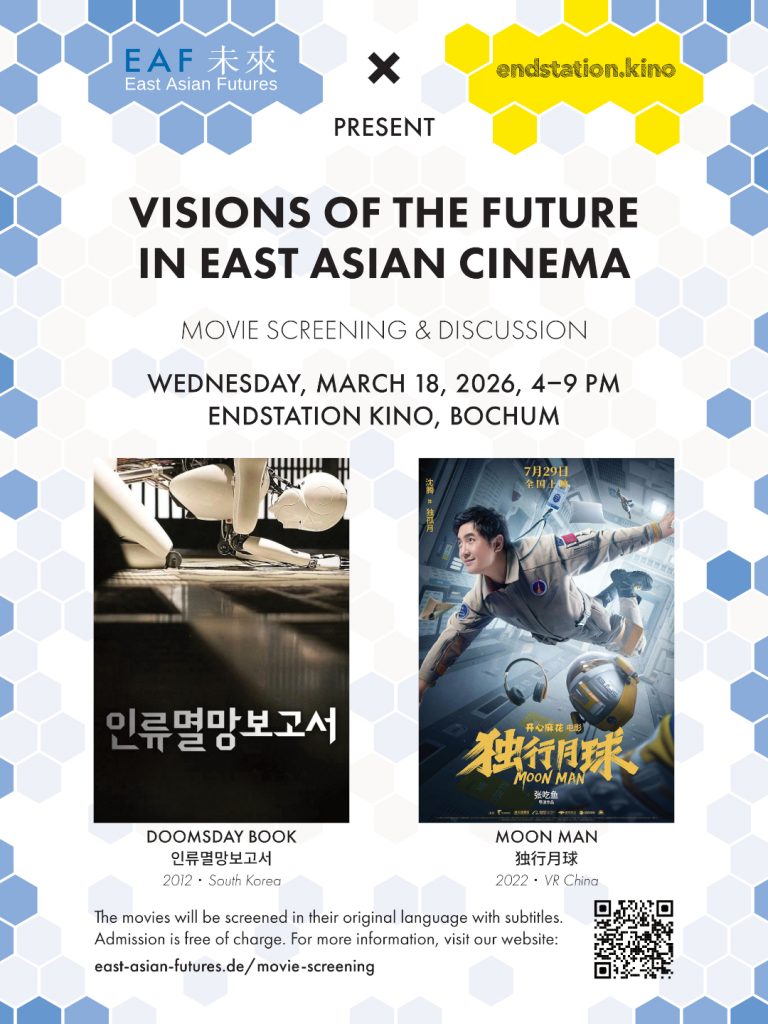
The Research Training Group GRK 2833 “East Asian Futures” is happy to present its public outreach event “Visions of the Future in East Asian Cinema.” Across two afternoons in March, we explored cinematic visions of the future from Japan, Taiwan, South Korea, and China. The selected films engaged with questions of technology, society, apocalypse, memory, and imagination. Each screening was introduced and contextualised by our PhD researchers and Qualifying Fellows, followed by a discussion. As a public outreach event,it was open to everyone, and admission was free of charge. Three of the four movies were screened in their original language with English subtitles. Only the Korean movie was shown with subtitles in German.
On March 5, 2026, 4–9 PM, we screened the Japanese anime film Metropolis (2001) and the Taiwanese genre-bending comedy Marry My Dead Body (2022). This screening took place in cooperation with the Studienkreis Film (SKF) at Ruhr University Bochum in lecture hall HZO 20.
On March 18, 2026, 4–9 PM, we presented the South Korean science fiction anthology Doomsday Book (2012) and the Chinese sci-fi comedy Moon Man (2022). This second event was organised in cooperation with the local cinema Endstation Kino (Wallbaumweg 108, 44894 Bochum).
We would like to extend our sincere thanks to both of our cooperation partners! Without their help, our public outreach event would not have been possible, and we are very grateful for their support.
The GRK organising team deserves great praise for the events. Isabelle Koldewitz, a student assistant majoring in Chinese Studies and Media Studies, carefully organised and executed every step of the process—from the screenings in the cinema and lecture hall to the blog posts—with the support of administrative coordinator Jonas Sohrweide, who organised the screening facilities and licences, and IT administrator Jan Wiemann, who designed the posters for the event and the blog websites.
General Information about Doomsday Book
Genre
Science fiction anthology film
Title
인류멸망보고서
Translated title
Literally: Report on the Destruction of Mankind
Officially: Doomsday Book
Release date
2012
Directed by
KIM Jee-woon 김지운
YIM Pil-sung 임필성
Screenplay by
YIM Pil-sung
LEE Hwan-hee 이환희
KIM Jee-woon
CHANG Chong-gyu 장종규
Cinematography
JO Sang-yun 조상윤 (A Brave New World)
KIM Ji-yong 김지용 (The Heavenly Creature)
HA Seong-min 하성민 (Happy Birthday)
Producers
CHOI Hyeon-muk 최현묵
KIM Myeong-eun 김명은
Robert OH
Production company
Zio Entertainments, Time Story Group,
Seoul
Running time
115 minutes
Languages
Korean
Introduction of the Program and the Team
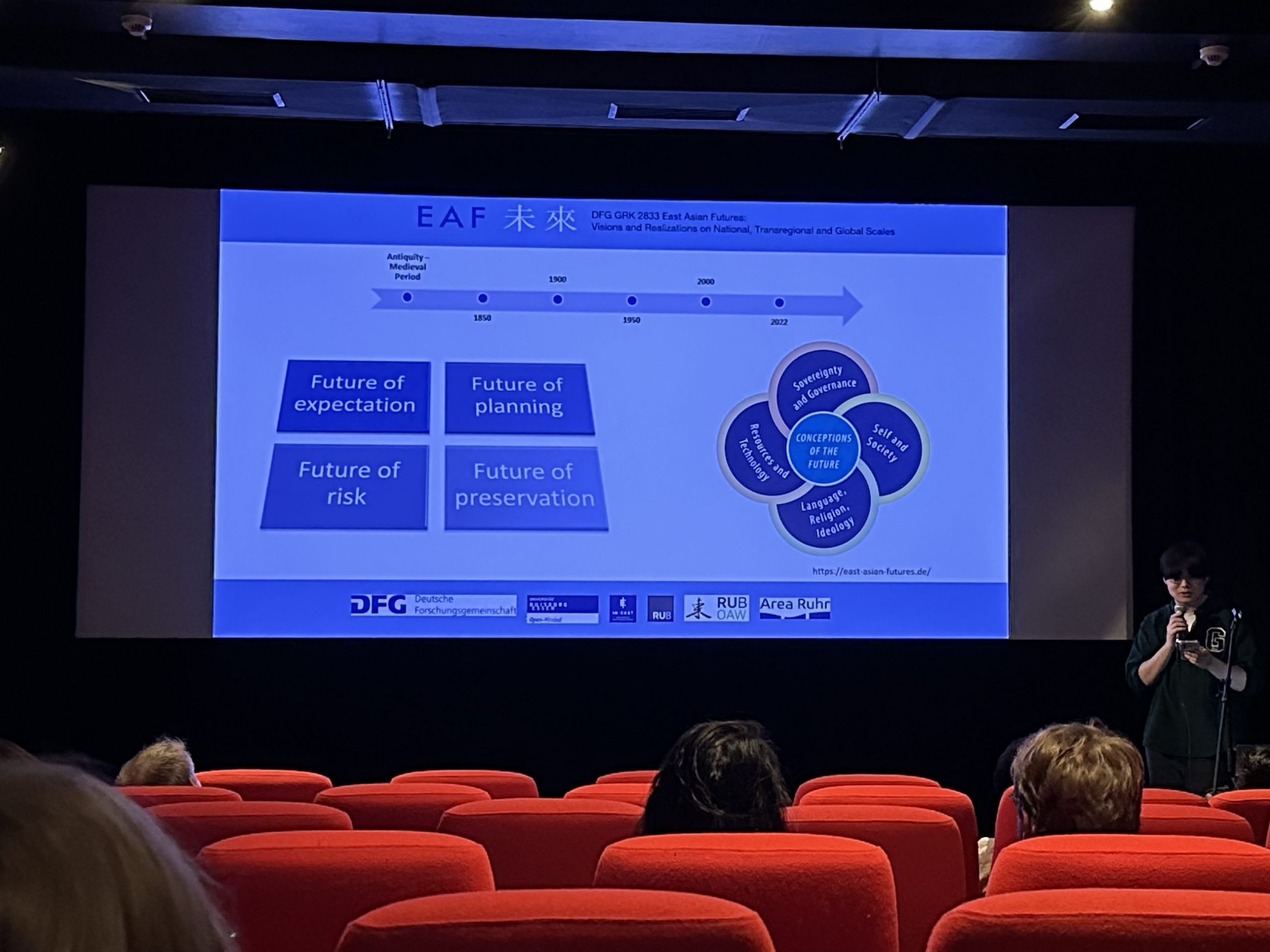
On March 18, 2026, during the second event in the “Visions of the Future in East Asian Cinema” series, Team Korea invited the audience to consider an important question: how do East Asian societies envision, plan for, and fear the future? This event was part of the Research Training Group GRK 2833, a DFG-funded initiative jointly run by the Faculty of East Asian Studies at Ruhr University Bochum and the Institute of East Asian Studies at the University of Duisburg-Essen.
To address the program’s main question, the research spans from around 1850 to the present, highlighting shifts from late imperial societies through colonialism and the Cold War to today’s globalised world. The program combines insights from the humanities, such as history, philosophy, and literature, with approaches from the social sciences, including economics and political science. The interdisciplinary approach enhances our understanding of how different visions of “futures” are created and negotiated.
Within this framework, the program identifies four modes of futurity. The future of expectation involves ideas of destiny and ideology, often influenced by religion and political beliefs. The future of planning is visible in strategies like state-led economic growth and urban development. The future of risk reflects concerns about crises, wars, and dystopian scenarios. Lastly, the future of preservation focuses on maintaining cultural heritage and the environment for future generations. These modes are examined through four thematic areas: self and society; language, religion, and ideology; resources and technology; and sovereignty and governance.
These themes can also be explored through cinema. While researchers analyse texts, archives, and policies to understand how futures are imagined, filmmakers do something similar through images and narrative. Film offers a space where multiple visions of the future can be staged, questioned, and reconfigured. The film event, therefore, helped us to consider how cinematic storytelling not only reflects but also questions how futures are thought and felt.
General Information about the Movie
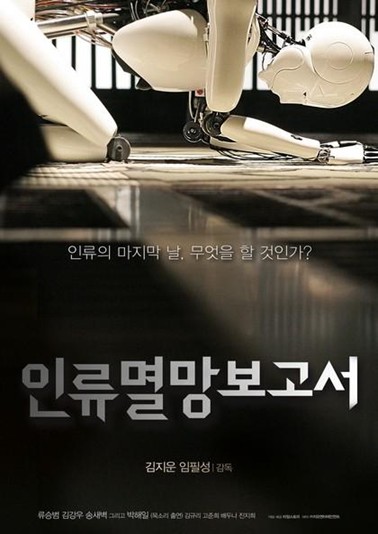
Doomsday Book (인류멸망보고서, 2012) is a South Korean science fiction anthology directed by Kim Jee-woon and Yim Pil-sung. Whereas the English title gives a general nuance of apocalypse, the literal meaning of the Korean title, “Report on the Destruction of Humanity”, already tells us something about the major themes of the movie. As an anthology, the film shows three very distinct future visions, and the stories are not directly related to each other. Genre-wise, these are not just traditional straight-up science fiction, but there is black comedy, horror, and emotional drama as well. The film’s length is 1 hour and 55 minutes.
Doomsday Book (인류멸망보고서, 2012) is a South Korean science fiction anthology directed by Kim Jee-woon and Yim Pil-sung. Whereas the English title gives a general nuance of apocalypse, the literal meaning of the Korean title, “Report on the Destruction of Humanity”, already tells us something about the major themes of the movie. As an anthology, the film shows three very distinct future visions, and the stories are not directly related to each other. Genre-wise, these are not just traditional straight-up science fiction, but there is black comedy, horror, and emotional drama as well. The film’s length is 1 hour and 55 minutes.
The film is made by two well-known directors, Kim Jee-woon and Yim Pil-sung. It was originally supposed to involve a third director as well, but after shooting the first two stories in 2007, the project ran out of funding, and the third segment was never made. The project was only restarted in 2010 with the two original directors collaborating to create a new third segment, and then finally released in 2012. For audiences already familiar with Korean entertainment, many of the actors will be familiar faces, such as Bae Doona, Go Joon-hee, and Ma Dong-seok. As an interesting detail, we can also look out for an acting cameo from the Oscar-winning director Bong Joon-ho, famous for films like Memories of Murder and Parasite, in the first story.
Critics received the movie well, though many have noted significant differences in quality and tone across the episodes. It ended up not being a big hit at the box office in Korea, despite winning a few awards. In other words, the movie did not achieve major box-office success, but it has remained notable for its ambitious attempt to explore multiple visions of human extinction.
Each episode depicts humanity’s doomsday from a different angle. The first story is called “A Brave New World,” where life is going on as usual in Seoul when suddenly a mysterious virus starts spreading through waste management, leading to a zombie apocalypse that turns most of the inhabitants into undead in a familiar dystopian setting.
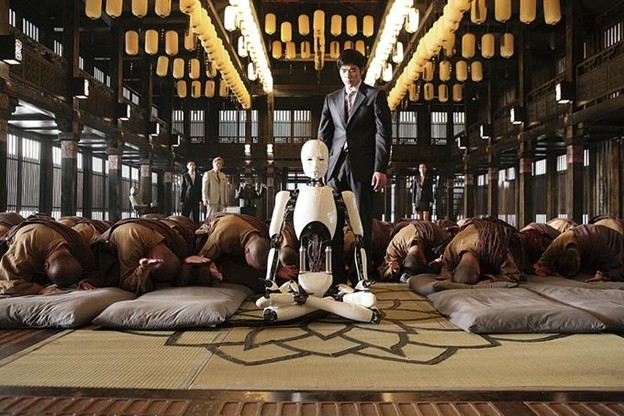
In the second story, named “The Heavenly Creature”, a robot at a Buddhist temple claims it has achieved enlightenment. The manufacturer of the robot starts seeing the robot as a threat and wants to turn it off, while others disagree, leading to a moral dilemma. This raises timely themes about the limits of artificial intelligence and its relations with humans, also something familiar to the Japanese movie Metropolis (2001).
The final story, “Happy Birthday”, shows another classic end-of-the-world scenario with a twist: a mysterious asteroid starts heading towards Earth. One family hides in an underground bunker and survives the impact, rising again to the surface years later to see how the post-apocalyptic world has changed.
Taken together, the three episodes do not simply imagine the end of the world. Rather, they show us different conditions under which the “end” becomes thinkable, and help the audience to reflect on the daily conditions that we have taken for granted.
Why Did We Decide on this Movie?
Doomsday Book uniquely visualises potential futures in the context of South Korean society. Rather than presenting a single, predictable path, futures in the movie emerge from many different forces such as human decisions, environmental conditions, technological systems, and sometimes pure contingency. The future here is not a singular outcome, but a set of possibilities shaped by different agents, systems, and contingencies. Throughout the film, the future moves from a pandemic catastrophe driven by mass consumption and pollution, through deeper questions about humanity’s place in a technologically advanced future, ultimately to the fragility of human life in the face of sudden, accidental cosmic threats.
At the same time, the film draws attention to another fundamental dimension of our life that has often been forgotten in the shade of the material world: spirituality. In the second episode, while the movie deals with the robot that goes beyond the human intellect, the question is no longer simply whether machines can think or act ethically. Instead, the movie asks whether a non-human entity can reach the stage of spiritual liberation. This deepens the discussion into a more profound realm relating to religious and philosophical concerns: who—or what—can become the subject of awakening, salvation, or transcendence?
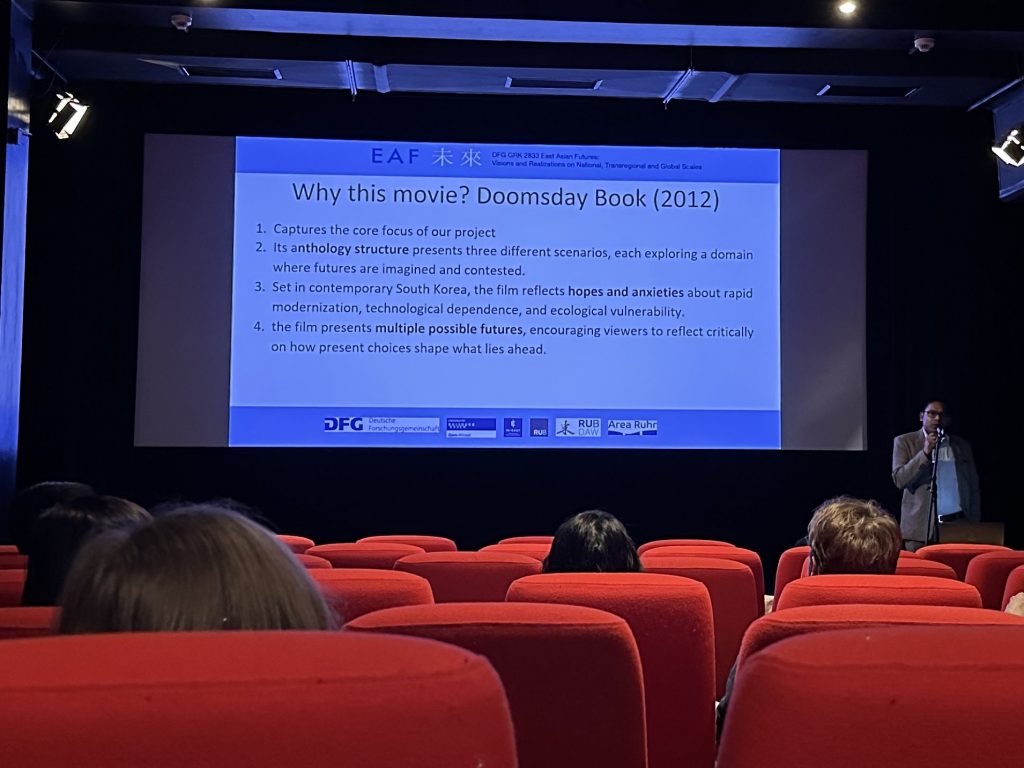
In doing so, Doomsday Book challenges anthropocentric assumptions that have been prevalent in modern humanism and dominant narratives of technological progress. In other words, the movie suggests that the future is not exclusively by, for, and about humans. Rather, futures take shape as complex entanglements among humans, technologies, and other forms of existence. Therefore, we can reconsider the boundaries of agency across different forms of being.
Diverse Futures
When we talk about the future, we often presume that there would be a particular one under everyone’s consensus. However, the South Korean movie, Doomsday Book (2012) takes a much more grounded—and perhaps, more realistic—approach. It shows us a future that is fragile and messy, shaped by the same social and ethical problems we’re dealing with today. The movie is split into three stories, and each one feels like a “what if” scenario that could actually happen. These aren’t just random sci-fi tales; they explore how our industrial world, our small mistakes, and our technology all crash into each other. In the end, it also makes you wonder: as the world changes, should humans still be the ones making all the rules?
This way of looking at things—seeing the future as a web of possibilities rather than a single straight line—is a big part of what we study in the “East Asian Futures” research group (GRK 2833). It’s about realizing that there isn’t just one future; there are many.
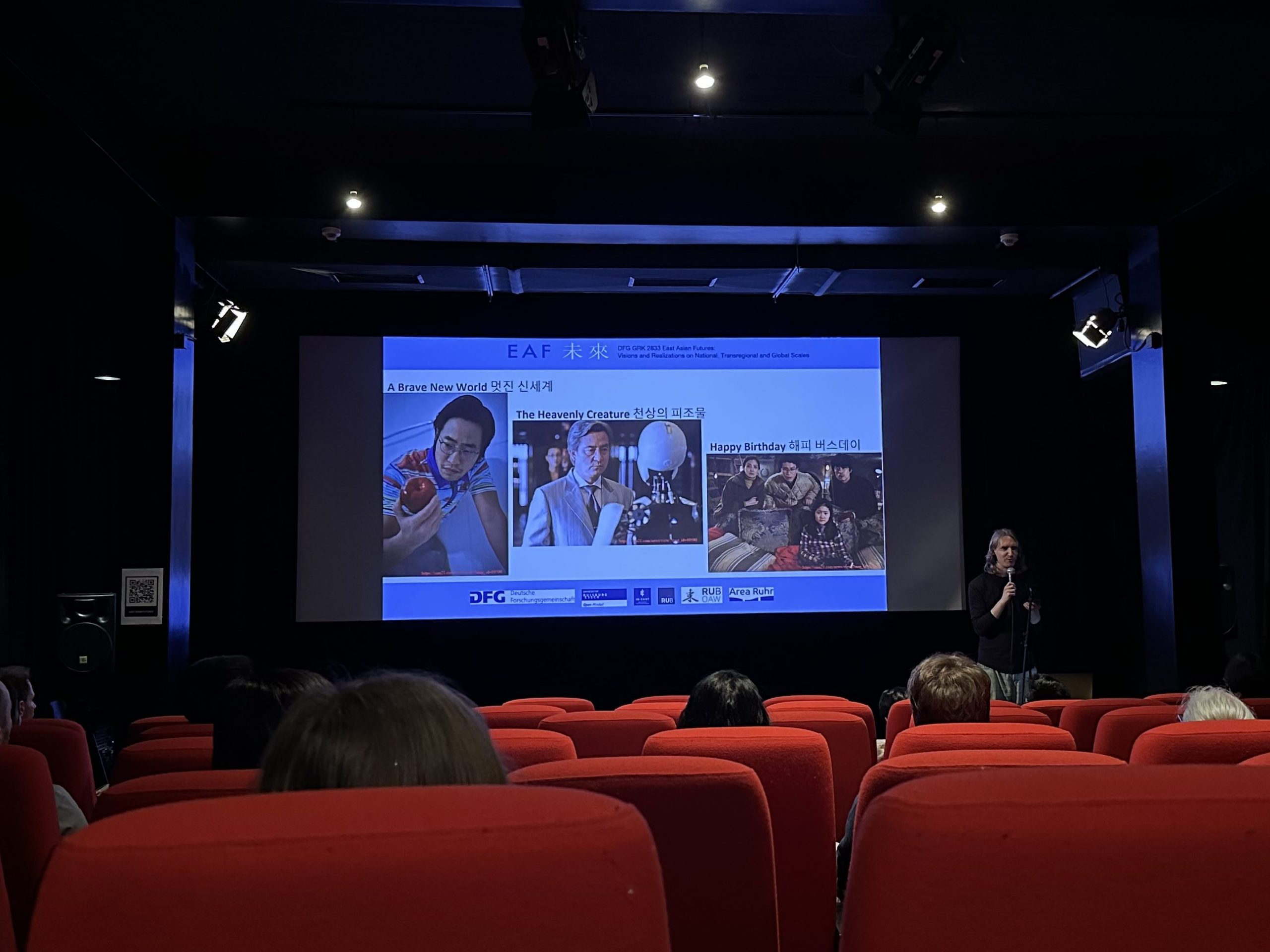
When we look at the three episodes, they don’t just show different futures; they show different ways the future can actually happen. In the first episode, we see a future built on long-term systems. Catastrophe emerges from the choices we’ve made over decades—our industries and our massive human-made structures. The second episode introduces a perspective in which ethical insight and moral agency may no longer be exclusively human. The third episode presents a contingent temporality in which small, accidental actions trigger disproportionate consequences. To sum up, the movie suggests that futures are not only multiple in content but also differ in how they unfold. This also reinforces the idea that the future is shaped through both long-term processes and unpredictable events. The movie closely aligns with key themes of GRK 2833, especially the link between technological transformation and uncertainty. It portrays South Korea as technologically advanced yet inherently fragile in its future. At the same time, the film portrays the coexistence of modern technology with older traditions such as Buddhist spirituality, which is an important aspect of East Asian societies. This is such a big part of East Asian life—the old and the new living in the same space. In addition, it reveals the hidden risks in a massive system of technology and shows how that system can produce unintended and potentially catastrophic consequences. These elements reflect broader concerns about sustainability, automation, and global interconnectedness.
Catastrophe: When Systems We Believed in Go Wrong
The concept of the future plays a significant role in studies of the ecological limits of the planet Earth. In this regard, one of the most important aspects of Doomsday Book is its portrayal of catastrophe as emerging from the everyday destruction of the ecosystem. The first story, A Brave New World 멋진 신세계, deals with one of the most common themes in the apocalyptic genre: a zombie outbreak. However, a distinctive point is that the zombie outbreak is not caused in a secret lab or a war. It starts with industrial food recycling. It’s a darkly funny but scary look at how our obsession with mass production and efficiency in daily life can have unintended consequences. As a result, it leads us to reconsider issues of mass production, environmental sustainability, and the unintended consequences of technological efficiency.
This suggests that the future is shaped not only by innovation, but also by the risks embedded in modern infrastructure. South Korea’s rapid economic development—often described as “compressed modernity”—has produced prosperity alongside environmental strain and technological dependence in Korean society.
The movie suggests that a catastrophe does not always take the form of an external invasion but can instead be an internal malfunction. The apocalypse is subtly systemic rather than loudly accidental. This resonates with broader concerns about supply chains, biosecurity, and urban density in highly networked societies.
Artificial Intelligence and Human–Technology Relations
The second episode, The Heavenly Creature 천상의 피조물, is probably the most thoughtful part of the movie. Most Western sci-fi movies (such as The Terminator) treat AI as a threat. But this story is different. It’s about a robot living in a Buddhist temple that seems to reach nirvana.
The RU4 is not a weapon or corporate tool, but a being that challenges existing assumptions about human privilege: the sole right to possess agency. When RU4 is considered to reach nirvana, the movie raises questions about whether consciousness and ethical awareness are limited to humans.
By placing artificial intelligence within a Buddhist temple, the movie connects technological futures with East Asian religious traditions. This reflects a future in which technological development does not simply replace tradition, but interacts with it in complex ways.
Rather than asking whether machines will dominate humans, the movie asks whether moral awareness and responsibility can extend beyond biological life. In other words, by putting a robot in a spiritual setting, the movie challenges our human-centered view of the world and suggests that the future might involve a much more complex relationship between us and our machines.
Contingency, Absurdity, and Collective Risk
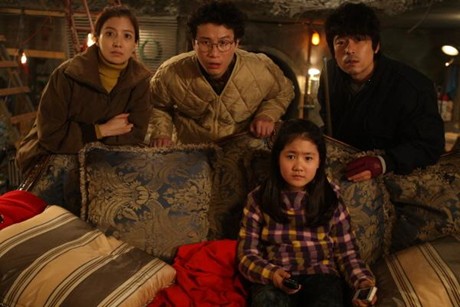
The final episode, Happy Birthday 해피 버스데이, is about an asteroid on a collision course with Earth. Even though the situation is dire, the tone is weird and funny. The tone blends dark comedy with a sense of inevitability. Although the setting is in a world after civilization is destroyed, we, the contemporary audience, still can grasp the sense of the movie, living in a crisis, since that is exactly what many people in today’s fast-changing societies feel on a daily basis.
Another focal point of the episode is the limits of human control. Despite our advanced technology, we’re still vulnerable to things we can’t control. A simple, accidental event—like a misplaced billiard ball—can change everything. The billiard ball’s recurring, improbable behaviour further emphasises contingency. Even within highly rationalised systems, unpredictable outcomes remain possible. The future cannot be fully controlled, even through advanced technology or global coordination. It’s a reminder that no matter how much we plan or coordinate, the future will always have a bit of unpredictable chaos.
To sum up, Doomsday Book doesn’t try to give us one coherent blueprint of the future. It shows us every potential future, biological collapse, technological confusion, and cosmic accidents, all at once. This plural structure mirrors the diversity of contemporary East Asian futures, such as the combination of technological development with uncertainty, risk, and reflection. Importantly, the movie avoids simple dystopian pessimism. Even in scenarios of destruction, there are moments of insight and ambiguity. Therefore, in the movie, we can observe that the future isn’t fixed. It’s an open space, constantly changing through our systems, our luck, and how we choose to respond to the world around us.
Four Modes of the Future and the GRK Framework
The movie can also be analysed through the four modes of the future proposed by Rüdiger Graf and Benjamin Herzog (2016): future of expectation, future of planning, future of risk, and future of preservation.
In A Brave New World, the future of planning appears in a failed form, as an unforeseen factor triggers a large-scale catastrophe that institutional systems cannot control. At the same time, the episode evokes the future of preservation by highlighting ecological interconnections and environmental concerns.
In The Heavenly Creature, there is a tension between different modes. The Buddhist monks (and perhaps at the end of the episode, the engineer who turned out to be a robot as well) approach the situation where RU4 attained the high wisdom that only a very small number of humans could achieve through the lens of the future of expectation. On the contrary, the CEO of the company that produced RU4 interpreted it through the lens of the future of risk, arguing how risky and uncertain humanity’s ever-changing technologies are.
In Happy Birthday, an unexpected cosmic event results in the future of risk, while the failure of technological systems points again to the limits of planning.
Through each episode, the movie shows that different modes of the future coexist and interact, rather than forming a single dominant framework. In this sense, it shows one of the essential aims of the research program GRK 2833: not to just predict the future, but to understand how different futures are imagined and generated.
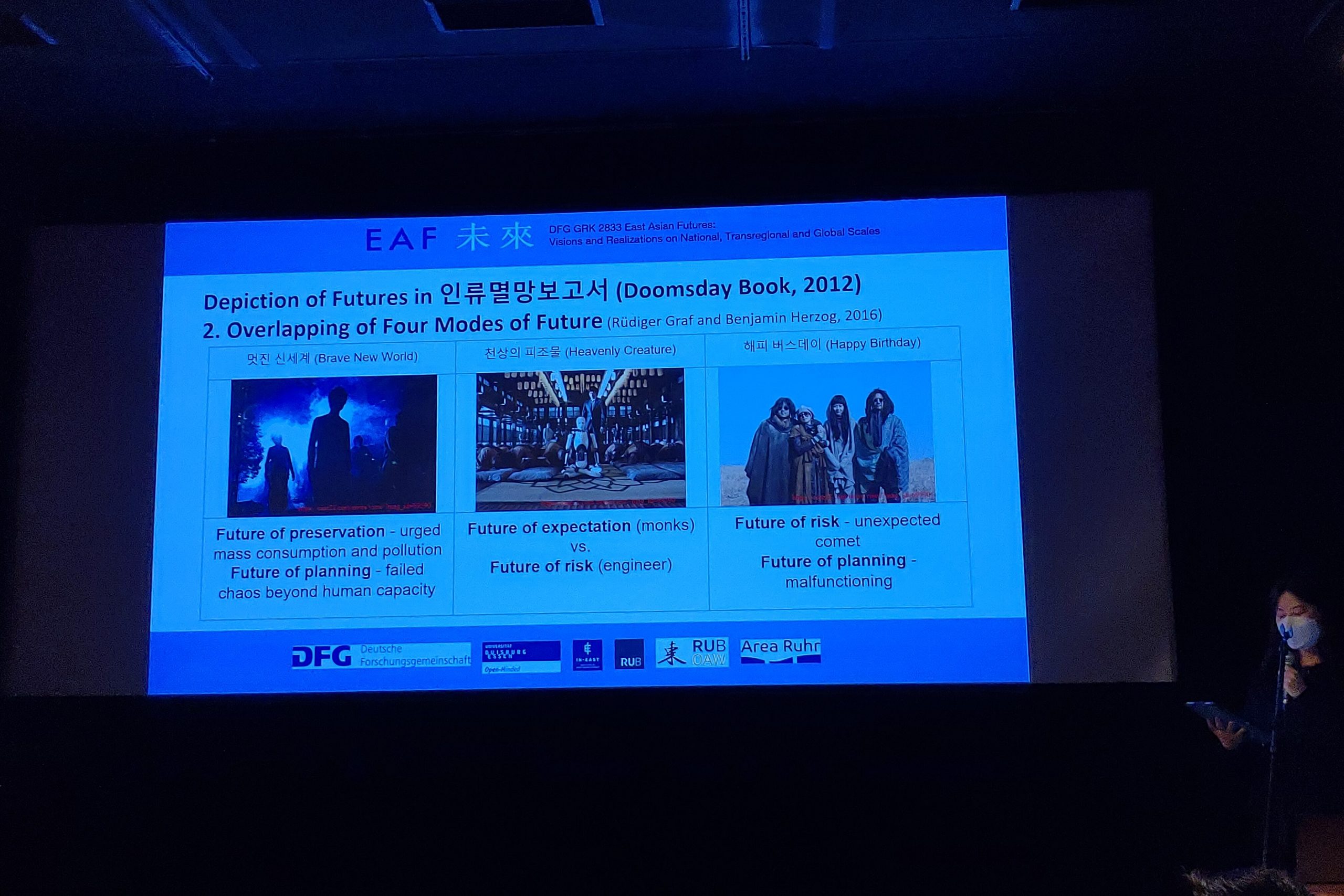
Through each episode, the movie shows that different modes of the future coexist and interact, rather than forming a single dominant framework. In this sense, it shows one of the essential aims of the research program GRK 2833: not to just predict the future, but to understand how different futures are imagined and generated.
Conclusion
Doomsday Book presents multiple visions of humanity’s possible future, ranging from systemic collapse to technological uncertainty and large-scale external threats. Whether it’s the failure of our big plans, our hopes for new technology, or the risks we didn’t see coming, Doomsday Book covers it all.
In line with the program’s framework, “East Asian Futures,” the movie highlights that the future is not defined solely by technological progress but also by systemic risk, unpredictability, and the interaction between human decisions and broader structures. It reminds us that the future isn’t just about progress—it’s about how we handle the unexpected. Also, the movie provides a social space that highlights issues of sustainable development, technological development, particularly Artificial Intelligence, and state collapse. Interestingly, since we are talking about the role of robots or humanoids and their participation in the spiritual realm, based on the movie filmed in 2012. Just after 13 years of this future vision, a recent news from the Jogye monastery of South Korea saw this expectation and speculation coming true on 7th May 2026, when a robot named “Gabi” participated in the Buddhist refuge ceremony called Sugye (수계), which involves taking refuge in the triple gem of Buddha, the Dharma, and the Sangha.
Thus, it provides a valuable perspective on how contemporary South Korean cinema imagines the future in a rapidly changing world.
References
- Faber, Liz W., “A (Wo)Man’s Touch: Doomsday Book as a critique of Metropolis”, in Global Perspectives on the Liminality of the Supernatural: From Animus to Zombi Gibson, ed. by Rebecca and James M. Vanderveen. Lanham: Lexington Books 2022.
- Graf, Rüdiger / Herzog, Benjamin, “Von der Geschichte der Zukunftsvorstellungen zur Geschichte ihrer Generierung: Probleme und Herausforderungen des Zukunftsbezugs im 20. Jahrhundert”, Geschichte und Gesellschaft, 42, 2016, 492–515.
- Moon, Gwang-lip, Hell-Joseon and Reconfiguration of Korean Modernity through Apocalyptic Imagining. Master’s thesis, Yonsei University 2018.
- Roberts, Lindsay, South Korean Zombie Cinema: Consumerism, Carnivores, and Ecocriticism. MA Thesis, University of Southern California, Los Angeles 2017.
- Shin, Haerin, “Affect in the End of Days: South Korean Science Fiction Cinema, Doomsday Book, and Affective Estrangement”, in Sonja M. Kim and Robert Ji-sung Ku (eds.), Future Yet to Come: Sociotechnical Imaginaries in Modern Korea, 225–244. Honolulu: University of Hawai‘i Press 2021. https://doi.org/10.1515/9780824889609-012.
Illustrations
- Image 1: Fotograph by S. Kortung
- Image 2: Movie Poster Illyu Myeongmang Bogoseo 인류멸망보고서 “Doomsday Book”,Website Naver, https://search.naver.com/search.naver?where=nexearch&sm=tab_etc&mra=bkEw&pkid=68&os=1794960&qvt=0&query=%EC%9D%B8%EB%A5%98%EB%A9%B8%EB%A7%9D%EB%B3%B4%EA%B3%A0%EC%84%9C%20%ED%8F%AC%ED%86%A0.
- Image 3: Fotograph by S. Kortung
- Image 4: Fotograph by S. Kortung
- Image 5: Film still from part 2, “The Heavenly Creature”, Website Cine21, https://cine21.com/news/view/?mag_id=69590.
- Image 6: Film still from part 3 “Happy Birthday”, Website Naver entertainment, https://m.entertain.naver.com/home/article/057/0001003303.
- Image 7: Fotograph by C. Moll-Murata