
By Konrad BÖHM, Charlotte DIRKS, Arne M. MEYER, XIONG Xiaoyu, GONG Buyun, Philipp MEIß, Liliia PEICHEVA, Anna-Maria RAU, Martyna SZOJA
The Public Outreach Event

The Research Training Group GRK 2833 “East Asian Futures” is happy to present our public outreach event “Visions of the Future in East Asian Cinema.” Across two afternoons in March, we explored cinematic visions of the future from Japan, Taiwan, South Korea, and China. The selected films engaged with questions of technology, society, apocalypse, memory, and imagination. Each screening was introduced and contextualised by our PhD researchers and Qualifying Fellows, followed by a discussion. As a public outreach event,it was open to everyone, and admission was free of charge. Three of the four movies were screened in their original language with English subtitles. Only the Korean movie was shown with subtitles in German.
On March 5, 2026, 4–9 PM, we screened the Japanese anime film Metropolis (2001) and the Taiwanese genre-bending comedy Marry My Dead Body (2022). This screening took place in cooperation with the Studienkreis Film (SKF) at Ruhr University Bochum in lecture hall HZO 20.
On March 18, 2026, 4–9 PM, we presented the South Korean science fiction anthology Doomsday Book (2012) and the Chinese sci-fi comedy Moon Man (2022). This second event was organised in cooperation with the local cinema Endstation Kino (Wallbaumweg 108, 44894 Bochum).
We would like to extend our sincere thanks to both of our cooperation partners! Without their help, our public outreach event would not have been possible, and we are very grateful for their support.
The GRK organising team deserves great praise for the events. Isabelle Koldewitz, a student assistant majoring in Chinese Studies and Media Studies, carefully planned and executed every step of the process — from the screenings in the cinema and lecture hall to the blog posts — with the support of administrative coordinator Jonas Sohrweide, who provided for the screening facilities and licences, and IT administrator Jan Wiemann, who designed the posters for the event and the blog websites.
General Information about Moon Man
Genre
Science fiction comedy film
Title
独行月球
Translated title
Literally: Walking on the Moon Alone
Officially: Moon Man
Release date
2022
Directed by
ZHANG Chiyu 张吃鱼
Written by
ZHANG Chiyu 张吃鱼
QIAN Chenguang 钱晨光
DAI Si’ao 戴思奥
SHEN Yuyue 沈雨悦
Based on
Moon You by CHO Seok 赵石
Producers
LIU Hongtao 刘洪涛
ZHANG Li 张莉
Production companies
Mahua FunAge 浙江开心麻花影业有限公司, Jinhua, Zhejiang
China Film Co., Ltd. 中国电影股份有限公司, Beijing
Alibaba Pictures 阿里巴巴影业(北京)有限公司, Beijing
Shanghai Ruyi Film and Television Production Co., Ltd. 上海儒意影视制作有限公司
Tianjin Maoyan Weiying Culture Media 天津猫眼微影文化传媒有限公司Xihongshi Film and Television Culture (Tianjin) Co., Ltd 西虹市影视文化(天津)有限公司
Running time
122 min
Language
Chinese
Introduction
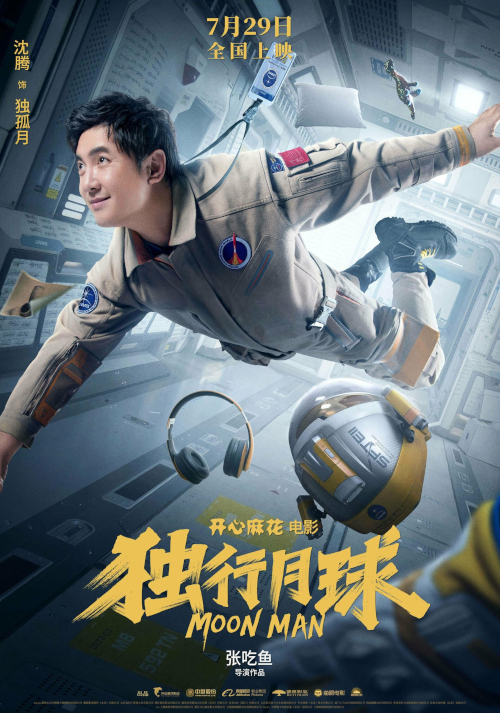
The story of “Moon Man“ is set in our near future, where space capabilities already drastically surpassed today’s expectations. The movie initiates its narrative by presenting us and mankind with an apocalyptic threat, a giant asteroid capable of destroying earth entirely. But while the initial reaction to such a threat would be to fall into panic, the Chinese scientists and officials are presenting a plan to prevent this impending doom. A permanent moon station is utilized to host 300 international experts for the construction of anti-asteroid missiles. While this mission ultimately fails to protect the earth from destruction, its parallels to today’s imagination of China’s future in outer space are remarkable. The leaders portrayed in “Moon Man” act on an established understanding of leadership based on long-term planning. It is similar to China’s socialist planning of development in outer space that emphasizes grand visions and long-term development goals to turn this envisioned future into reality. This essay will showcase how the fictional events of “Moon Man” relate to our reality in the context of China as an advocate for peaceful cooperation under the umbrella of the UN, explain the greater context of today’s and future space programs, introduce the concept of soft power, highlight the importance of Chinese heroism as a symbol for the future, and finally remark on the use of entertainment in the movie.
Yi he wei gui 以和为贵 or Valuing Harmony Above All – China, the UN and Peaceful Cooperation
One of the opening scenes of the movie shows China receiving permission from the UN to embark on the space mission to destroy the asteroid. This aligns well with China’s discourse on adhering to international law. In fact, China claims that the five leading principles of its foreign policy and constitution are anchored in the later. The principles are:
- mutual respect for territorial integrity and sovereignty
- mutual non-aggression
- non-interference in internal affairs
- equality and mutual benefit
- peaceful coexistence.
By receiving permission from the UN for the mission, China confirms its peaceful intentions and demonstrates that it acts with the consent of humanity.

This point is important because China is often perceived as threatening and aggressive (Buzan 2010). To push back against this negative discourse, China emphasizes that its behavior is lawful and that the country stands for world peace. In their analysis of the CCTV documentary “Daguo Waijiao”, Priupolina et al.[1] show that China uses the medium of filmmaking to demonstrate to the world that it does not intend to eliminate world institutions, but rather to modify and make them more inclusive. This, in turn, should counteract the threat narrative.
Although China is critical of Western-led global institutions, it has nevertheless benefited enormously from them. As we see in the movie, China believes that a UN framework should exist in the future to maintain global cooperation and make international relations more predictable. At the same time, the film shows that China wants a leading position in these institutions: China is not isolated, but cooperates with the rest of humanity.
Moreover, references to the UN and other global institutions allude to China’s peaceful intentions in outer space. According to the Outer Space Treaty, no country can claim sovereignty over space, which should be used only for peaceful purposes. Despite many reports of China’s ulterior motives in space exploration, the scene should demonstrate China’s leadership in the field while also showing that China is not breaking international law.
[1] Priupulina / Eckstein / Noesselt 2025.
The Greater Context of China’s Space Programs – Between Fiction and Reality
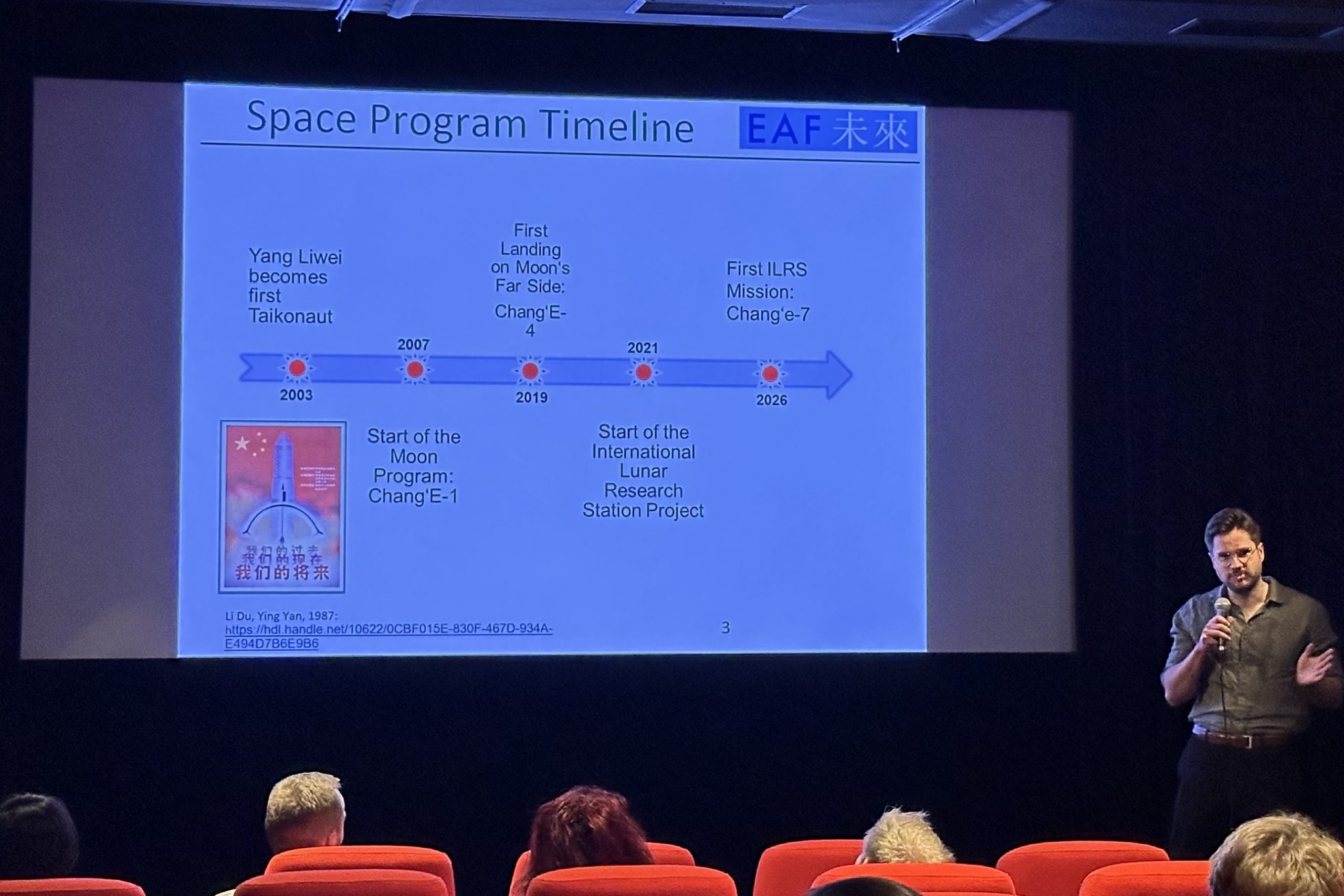
The first thoughts of China as a space nation were made in 1956, when Premier Zhou Enlai started the expert commission on the “1956—1967年科学技术发展远景规划”, the country’s first Science and Technology Development Plan. Since then, long-term planning has been the guiding principle of developing outer space capabilities. And China’s leadership stayed true to this “future of planning” approach applied through top-down initiatives to reach future goals or prepare for future concerns when they developed concrete plans for outer space programs. Under Mao Zedong, China’s space programs were combined with the development of nuclear weapons and satellites, as evident in the 1958 “liang dan yi xing” 两弹一星”—two bombs one satellite program.[2] After an era of uncertainty and stagnation during the cultural revolution, the ambitions for Chinese domestic space programs have continuously risen to new heights. Under Xi Jinping, the planning as well as the success of China as a space nation reached multiple milestones. From the country’s first global satellite navigation system to a domestic permanent space station towards world-leading milestones. Xi Jinping’s current plans in outer space are closing the narrative circle with the topic of our movie, the exploration of the moon and the construction of a permanent moon base.
The moon base we see in the movie could be the future version of the planned International Lunar Research Station ILRS, planned together with Russia and 16 other countries to construct a permanent base on Luna’s surface. According to the two project leaders, Russia’s Roscosmos and China’s CNSA, the first permanent base will be finished in 2035, providing a basic lunar ground station (CNSA, 2023). While the IRLS partner countries are currently still in the starting phase of reaching the moon in the first phase, the ambitious long-term planning character of China’s space pioneers already envisions the coming decades. Until 2045, the base and moon infrastructure shall be upgraded to host additional crews, referred to as “taikonauts“, rather than “astronauts“ or “kosmonauts“. Then the moon shall become earth’s home port and serve as the starting point for expeditions” towards Mars, the asteroid belt and beyond. While Chinese officials strictly reject the claim of competition between Chinese and US-led space programs, Western experts are engaging in a discussion whether today’s contemporary and planned space activities can be considered a new “Space Race”, similar to the character of USA vs. Soviet Union space competition during the 20th century. Zhang’s “Moon Man” engages this sensitive topic in a comedic manner. The audience sees Dugu Yue, the main character, as he accidentally steps on mankind’s first lunar footsteps made by Neil Armstrong’s historic giant leap in 1969. While this scene mainly serves as a comedic relief sequence, it also shows the audience that the old US dominance of lunar exploration is now overshadowed by China. A similar analogy is evident during the third act. Yue and his Australian companion need to utilize the old American tech, left behind by the Apollo 17 mission that marked the end of the US’s moon exploration era. In the end, the mission is successful through the combination of old US- and new Chinese technology. While this result is in line with China’s narrative of rejecting competition and promoting peaceful win-win cooperation, it also presents a clear symbolism that the future of outer space technology is not achieved through the USA but through Chinese innovative power.
Chinese leadership understanding is also visible in the movie’s portrayal of communication of earth’s last defense force. The director mainly shows Chinese leaders as heads of an UN-led defense initiative to the audience. People from other continents or countries play the role of grateful followers who enact the commands of the headquarter based in China. The movie does not need to explicitly explain to its audience that China is now the undisputed leader in outer space, for we do not see any other competent headquarters besides the one in China. As “Moon Man” is directed to be a lighthearted comedy, one should not make the mistake of overinterpreting this evidence mentioned prior. The dominant presence of China and Chinese actors can be plausibly explained by the fact that the movie is made by Chinese directors for a domestic audience. However, when examined from a perspective based on international cooperation and relations, this representation leads to the portrayal of China as the new Global Leader in Outer Space, unanimously accepted by the remaining humans. Building on this broader context of China’s long-term space ambitions, the asteroid scenario in “Moon Man” can be read in relation to a more specific field of policy and research: planetary defense. Continued attention to near-Earth objects such as Apophis shows that asteroid threats are not merely fictional, but part of an ongoing planetary defense discourse (ESA n.d.).
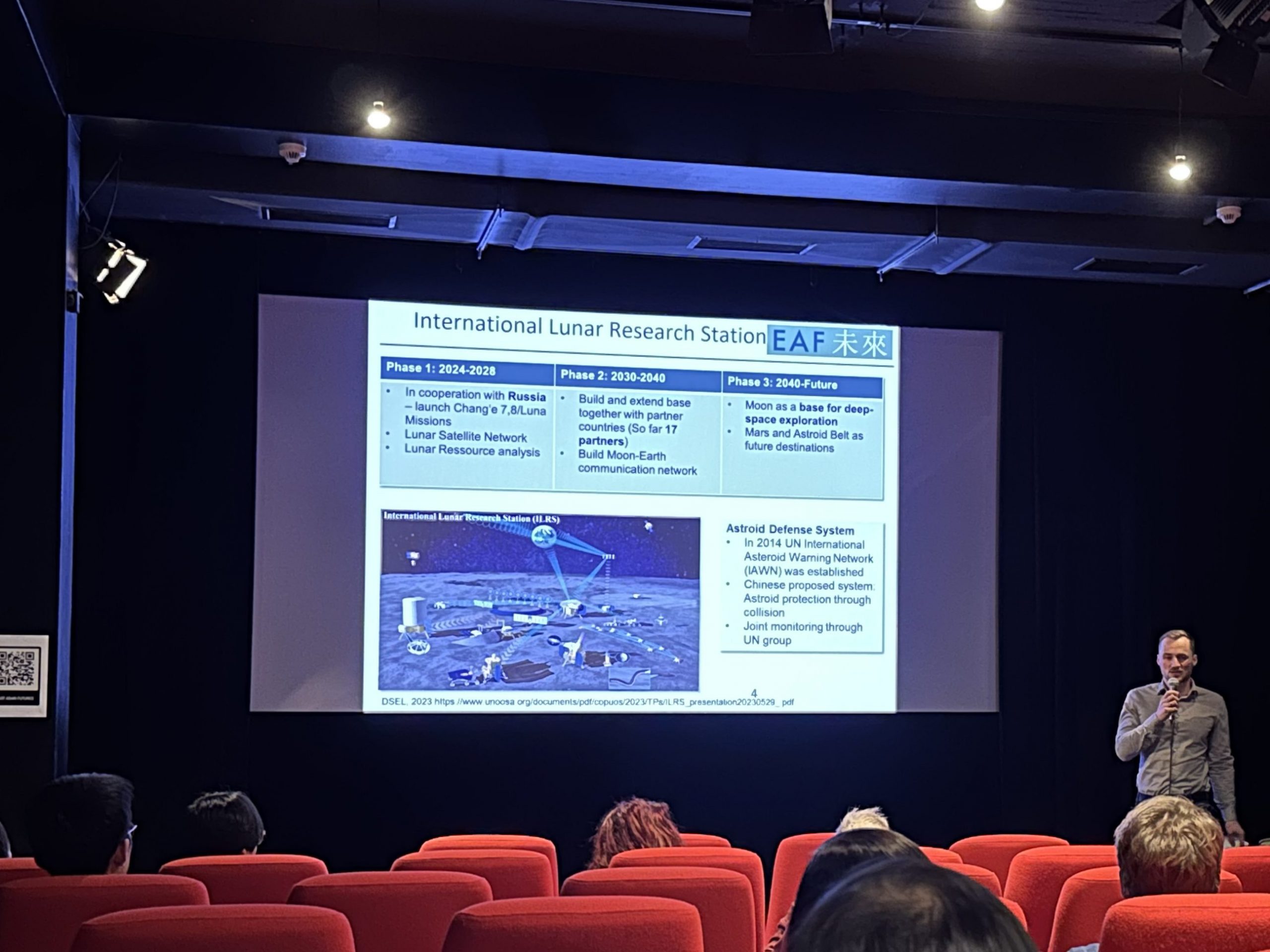
The movie’s depiction of anti-asteroid measures is fictional and exaggerated, but it does not emerge in a political vacuum. In the white paper “China’s Space Program: A 2021 Perspective,” the State Council Information Office of the People’s Republic of China (2022) stated that China would study plans for building a near-Earth object defense system and strengthen capacities for near-Earth object monitoring, cataloging, early warning, and response. This suggests that asteroid defense had already entered official Chinese planning before the movie’s release, not as a marginal science fiction idea, but as part of a broader agenda of space governance and long-term technological development. Official statements became more concrete in 2024, when Wu Weiren, the chief designer of China’s lunar exploration program, announced at the China Space Conference that China had already begun an asteroid defense plan and was preparing a kinetic-impact test mission around 2027, including an in-orbit assessment of the impact’s effectiveness (CNSA 2024). Such statements suggest that the idea of actively responding to asteroid threats has moved beyond abstract rhetoric toward more operational forms of planning. Furthermore, Li and Wang (2022) describe planetary defense in China as an increasingly visible research field that includes policy planning, monitoring and warning technologies, impact hazard assessment, on-orbit defense technologies, and international cooperation.[3]
Against this background, “Moon Man” can be interpreted as a popular-cultural dramatization of an emerging real-world discourse. The movie turns an abstract and highly technical field of policy and research into a humorous, emotional, and heroic narrative. At the same time, it reinforces the broader image already identified in the previous section: China appears not only as an ambitious spacefaring nation, but also as a technologically capable actor able to confront threats to humanity on a planetary scale.
[2] Liu 2019.
[3] Li / Wang 2022.
Moon Man and Soft Power
Cinematography is a clear example of soft power in practice. The concept was introduced by the American political scientist Joseph S. Nye Jr., who distinguished between hard power – based on coercion or economic incentives, and soft power – which relies on attraction and persuasion. As he summarized, “hard power is push; soft power is pull” (Nye, 2021).[4] Soft power therefore refers to a state’s ability to influence others through culture, values, and narratives rather than through military or economic pressure. In China, the idea gained prominence after a speech by Hu Jintao at the 17th Congress of the Chinese Communist Party in 2007. Since then, Chinese leaders, including Xi Jinping, have emphasized strengthening China’s cultural influence abroad and “telling China’s story well.” Cultural industries such as film, television, and music play a key role in this strategy, although Chinese productions have not yet achieved the same global reach as American or Korean cultural exports.
This discrepancy is also evident in the reception of Moon Man: despite making over 1 billion RMB at the Chinese box office, the movie failed to gain substantial recognition abroad.

An important institutional framework shaping Chinese cinema is the state approval system. At the beginning of many films released in mainland China, including Moon Man, a green screen with a golden dragon emblem appears. Often referred to as the “Dragon Seal,” it indicates that the film has received a Public Screening Permit (gongying xukezheng 公映许可证) issued by the China Film Administration. This approval confirms that the film has passed the official review process and is authorized for theatrical distribution. The administration operates within the state media and propaganda system under the Chinese Communist Party.
To obtain this permit, films must comply with political, moral, and cultural guidelines. Productions must avoid criticism of the Chinese political system, separatist narratives, or portrayals that could damage China’s national image. Content is also reviewed for excessive violence, explicit sexuality, or depictions considered socially disruptive. As a result, the approval system not only regulates the domestic film market but also is a tool of soft power and shapes the themes and narratives presented in Chinese films.
Since Moon Man is a sci-fi movie set in the future, it only has few connections to ancient Chinese practices, with the exception of the influencer playing traditional Chinese music on his flute. However, parallels to Chinese values can be drawn to the vision of the future portrayed in the movie, in which the world is governed through international organizations like the UN (with China playing a leading role, however) and people from all over the world work together harmoniously to save the Earth, reflecting China’s support for multilateralism and a Community of Common Destiny. The movie itself can also be considered a reflection of current soft power dynamics in the world and how cultural exports from different countries interact with one another. The main piece of music in the movie, which is the female protagonist’s favorite song and is played repeatedly to convey emotions of longing, is in fact the American country song “Take Me Home, Country Roads”, speaking to the popularity of American music worldwide. It is also striking that the movie shows connections to other movies released before and after, some stronger than others. In the Oscar-winning American sci-fi movie Gravity (2013), for instance, the protagonist, who also finds herself alone in space, uses the remnants of a Chinese space craft to return to Earth. In Moon Man, the protagonist uses the remnants of a space craft of a failed American space mission to return to Earth. One could also draw parallels to the movie Space Man (2024), in which the protagonist shares his space station with a giant spider instead of a kangaroo. Even though it is impossible to determine how much of an influence these cultural exports really had on one another, it is sound to assume that some inspirational connections exist.
[4] Nye 2021.
Chinese Heroism as a Symbol for the Future
From battlefield martyrs to model workers, socialist heroes were typically depicted as virtuous, disciplined, and iron-like figures. The moment of heroization often arrived through tragic self-sacrifice for the collective. The heroic body rarely displayed ambivalence or doubt; absolute loyalty to the Party left little room for what might be called ‘private emotions’—love, hesitation, or personal desire. Diffused through literature, cinema, theater, and propaganda posters, Maoist heroism functioned as a moral compass, orienting individuals toward a revolutionary subjectivity grounded in self-sacrifice for socialism. It is in this function of heroism as a mode of subject-hailing that the Maoist China found a formula for sustaining the promise of a bright socialist future.
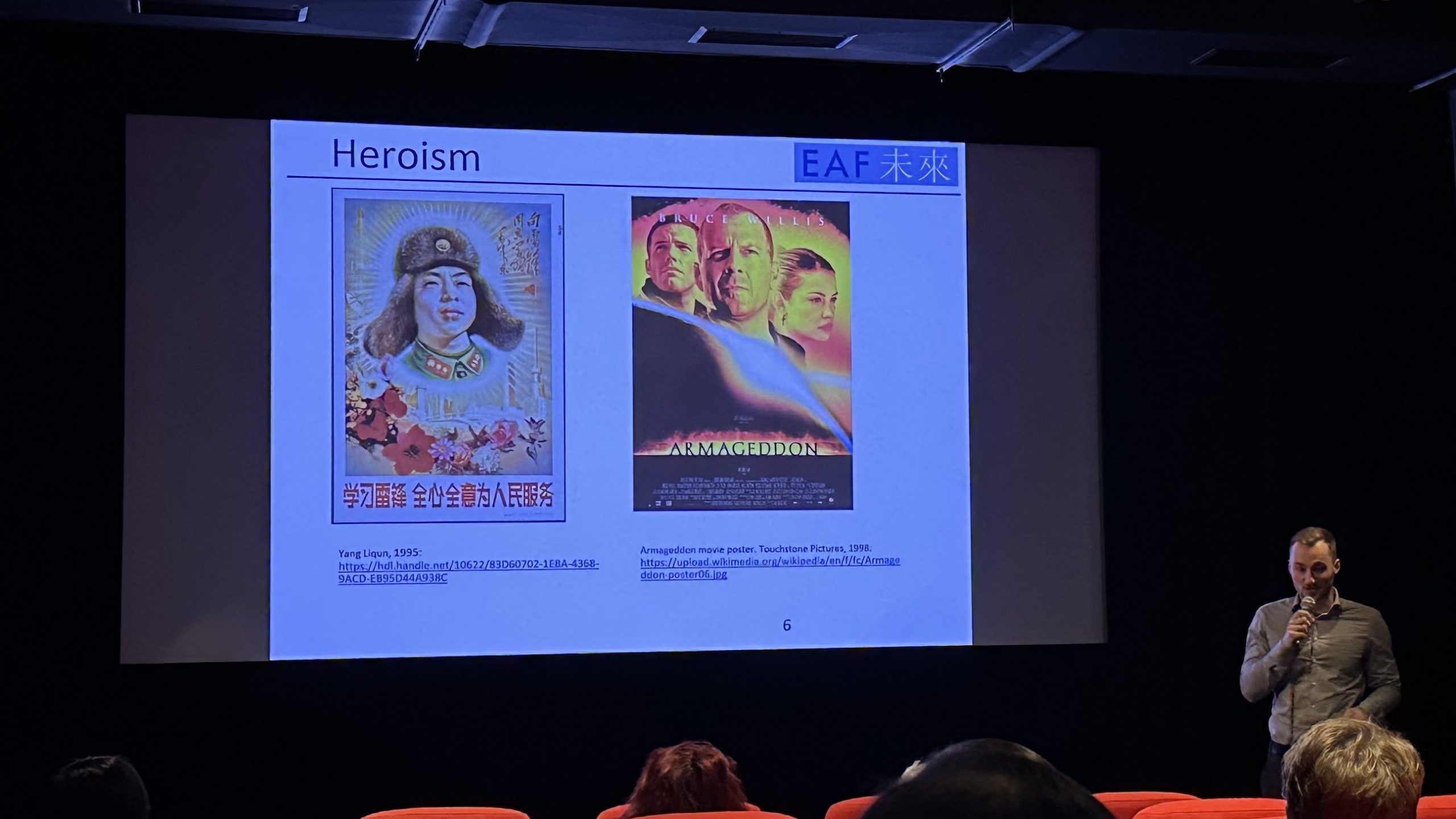
The film draws on elements of the Maoist-socialist heroic tradition while simultaneously reconfiguring them in a comedic manner that better fits both the contemporary film market and a post-heroic era. The main character Du Guyue (独孤月), literally “Lonely Moon” is not a typical Hollywood me-against-the-world kind of hero but a continuation of the me-for-the-party-state kind of figure. Whereas the Maoist heroic archetype was famously known for its discipline and iron character, Du Guyue is portrayed as clumsy, sentimental, and funny. He joins the lunar project not because of his revolutionary virtue but out of mundane desire of love. He panics, jokes, improvises, and embarrasses himself.
The film draws on elements of the Maoist-socialist heroic tradition while simultaneously reconfiguring them in a comedic manner that better fits both the contemporary film market and a post-heroic era. The main character Du Guyue (独孤月), literally “Lonely Moon” is not a typical Hollywood me-against-the-world kind of hero but a continuation of the me-for-the-party-state kind of figure. Whereas the Maoist heroic archetype was famously known for its discipline and iron character, Du Guyue is portrayed as clumsy, sentimental, and funny. He joins the lunar project not because of his revolutionary virtue but out of mundane desire of love. He panics, jokes, improvises, and embarrasses himself.
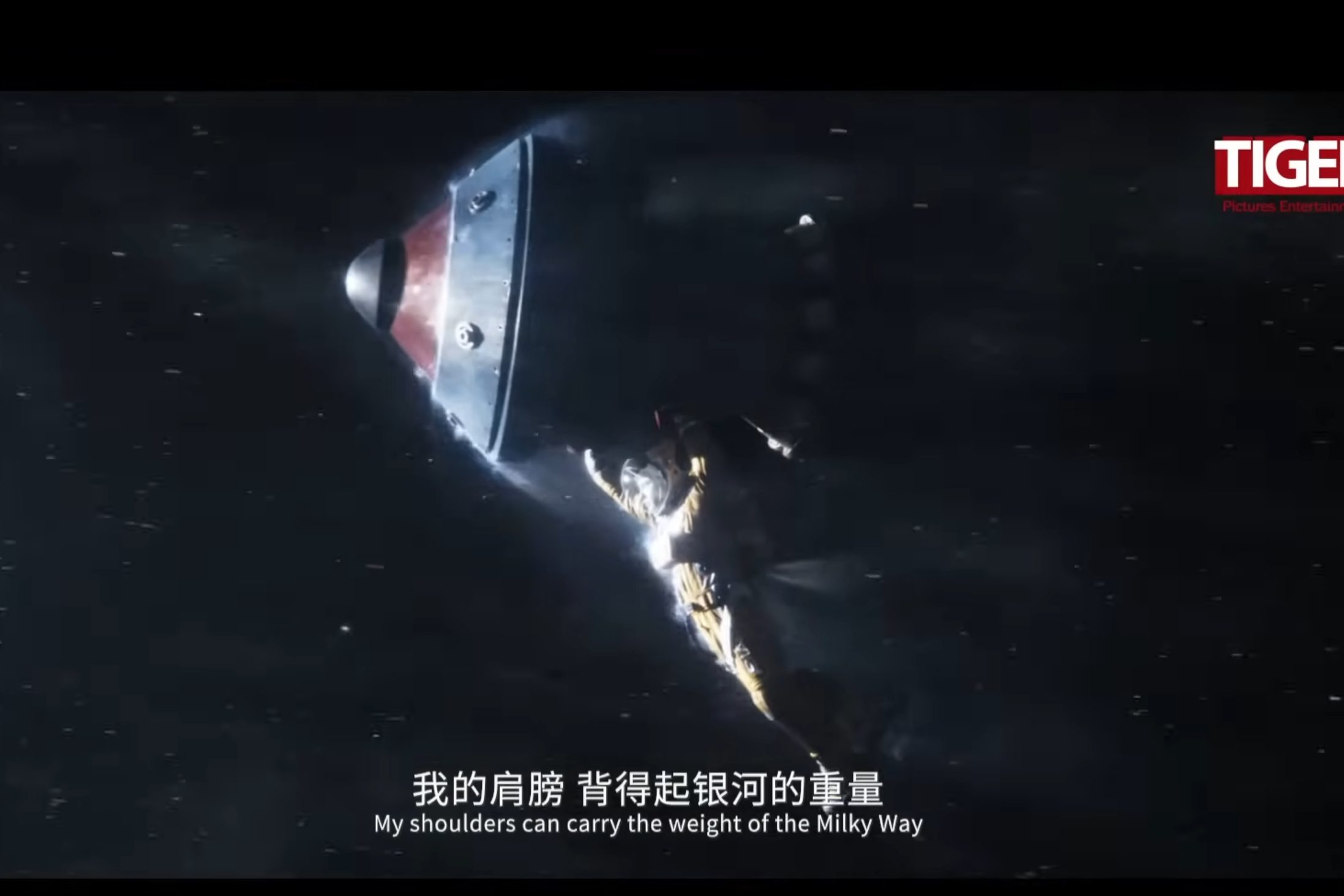
As Ulrich Bröckling argues in his book Postheroische Helden, the post-heroic era does not signify the disappearance of heroic orientation but rather its becoming problematic and reflexive.[5] One puzzling question is how to satisfy the enduring desire for heroic figures while audiences have grown skeptical of traditional heroic narratives. Seen in this light, Moon Man touches precisely on the paradox of the post-heroic hero. Rather than mobilizing the solemn pathos typical of socialist heroic narratives, the film offers a lighter, almost therapeutic tone—a kind of cinematic ‘chicken soup’ for surviving in an age saturated with apocalyptic imaginaries. Many contemporary disaster and dystopian narratives, from 2012 and The Day After Tomorrow to The Road and Child of Men, amplify a sense of impending catastrophe, echoing the urgent call of Greta Thunberg—“I want you to panic.” Moon Man, by contrast, deliberately softens this atmosphere of catastrophic seriousness. Through humor, sentimentality, and absurdity, it transforms apocalyptic anxiety into a form of collective emotional relief.
[5] Bröckling 2020, 10-20.
Entertainment in Times of Crisis
Facing the partial destruction of the planet, which rendered the earth’s surface largely inhabitable, the surviving part of humanity was forced to move underground. Although the people’s basic survival needs are met, the team of the Moon Aerospace Research Agency (MARA) is concerned about skyrocketing depression rates.
Instead of focusing on post-crisis rebuilding efforts, the MARA team is given the task of broadcasting a livestream of Dugu Yue, the single survivor on the moon, to all survivors on earth. The goal of this measure is to make him into a hero and a role model who will “drive away the fears”, help the people to “find hope for the future”, and thereby aid humanity’s survival.
Hence, while humanity barely withstands extinction and actively struggles with self-preservation, the MARA team commences to use its entire time and resources to create an in no way informative, emotionalized, unintentionally entertaining, and heavily curated livestream of the lonely, but safe and well-provided-for protagonist’s daily life on the moon, which is rendered into a hero narrative. The movie depicts this approach with a humor that is tuned up to absurdity. However, providing entertainment and creating a semblance of community is a proven method to ensure people’s willingness to carry on in times of crisis. One of many historical precedents can be found in China during the War of Resistance (1931–1945) when music groups provided emotional connection, motivation in patriotism, morale and entertainment.[6]
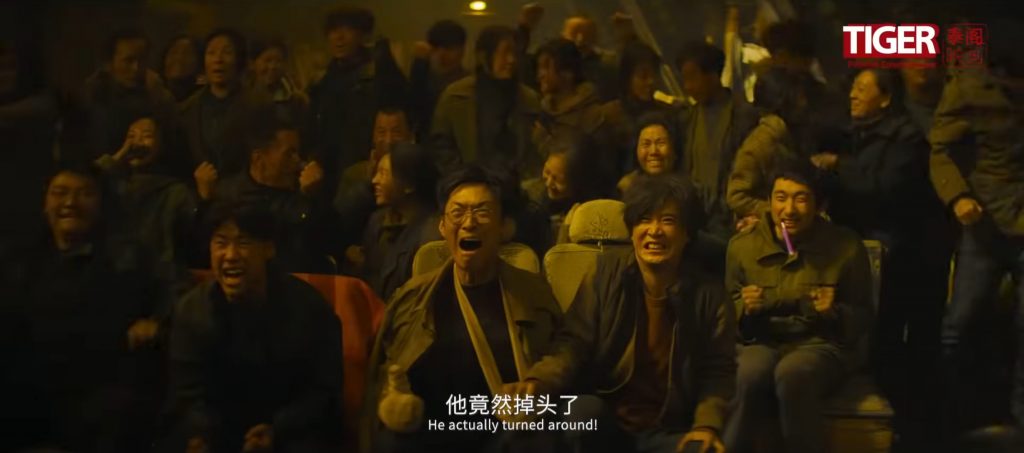
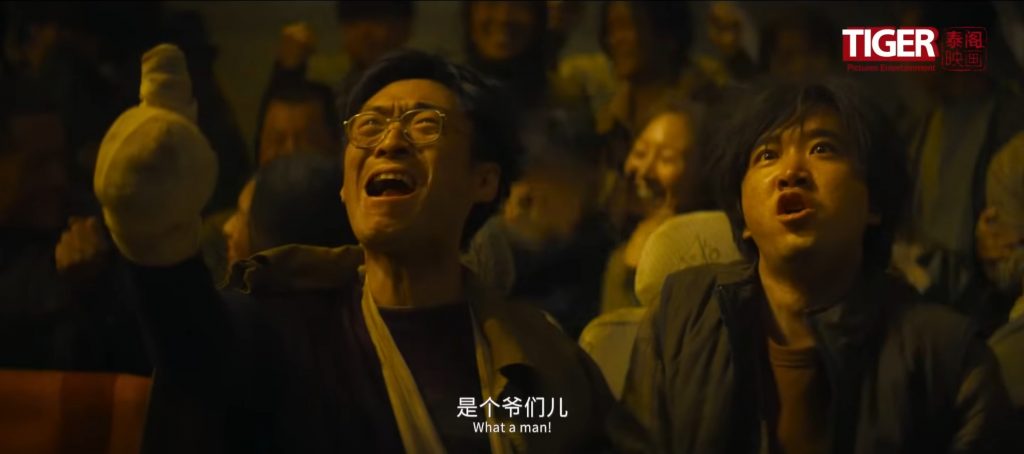
The movie presents the livestream as a way to comfort people who have lost their will to live, encouraging them to carry on and contribute to society. It suggests that, beyond basic survival needs, people require a driving force, which can be fostered by a compelling and entertaining story. Even in crisis, (para)social bonds matter, as survivors find solace in seeing the main character braving his trials, highlighting how uplifting content may act as a gateway for emotional connection, compassion, and identification. At the end, it is not the space program, not the great, advanced technology, but the life stream and the story of Dugu Yue that gives the survivors hope to actively strive and struggle for survival.
[6] See (Howard 2014). Howard does not stress the element of entertainment, but it is an implicit factor in the success of mobilization efforts.
References
- Bröckling, Ulrich, Postheroische Helden: Ein Zeitbild. Berlin: Suhrkamp Verlag 2020.
- Buzan, Barry, “China in International Society: Is ‘Peaceful Rise’ Possible?”, The Chinese Journal of International Politics, Vol. 3/1, 2020: 5–36, https://doi.org/10.1093/cjip/pop014.
- CNSA, “Duoxiang zhongdian renwu pilu! Zhongguo youwang chengwei shouge →” 多项重点任务披露!中国有望成为首个→ (Several Key Tasks Revealed! China May Become the First →), April 26, 2024,https://www.cnsa.gov.cn/n6758823/n6758838/c10517120/content.html.
- CNSA “International Lunar Research Station“, Deep Space Exploration Laboratory of CNSA, May 2023,https://www.unoosa.org/documents/pdf/copuos/2023/TPs/ILRS_presentation20230529_.pdf
- ESA. n.d. ‘Apophis’. European Space Agency. Accessed 18 May 2026. https://www.esa.int/Space_Safety/Planetary_Defence/Apophis.
- Howard, Joshua. “’Music for a National Defense’: Making Martial Music during the Anti-Japanese War.” CrossCurrents: East Asian History and Culture Review 13, 2014, 1–50, http://cross-currents.berkeley.edu/e-journal/issue-13.
- Li, Mingtao / Wang, Kaiduo, “Progress of Planetary Defense Research in China”, Chinese Journal of Space Science, 42/4, 830–835,https://doi.org/10.11728/cjss2022.04.yg27.
- Liu, Yanqiong, “Chinese Academy of Sciences and Project of ‘Two Bombs, One Satellite’”, Bulletin of Chinese Academy of Sciences (Chinese Version), 34/9, 2019, Article 4, https://doi.org/10.16418/j.issn.1000-3045.2019.09.005
- Nye, Joseph S.,“Soft Power: The Evolution of a Concept”, Journal of Political Power, 14/1, 2021, 196–208, https://doi.org/10.1080/2158379X.2021.1879572.
- Priupolina, Elizaveta / Eckstein, Tanja / Noesselt, Nele, “Cooperative, Competitive and Responsible: the Visualization of China as a Major Power and its Global Roles in the CCTV Documentary Daguo Waijiao”, The Pacific Review, 38/1, 119–146, https://doi.org/10.1080/09512748.2024.2356865.
- State Council Information Office, “China’s Space Program: A 2021 Perspective. The State Council of the People’s Republic of China”, January 28, 2022,https://english.www.gov.cn/archive/whitepaper/202201/28/content_WS61f35b3dc6d09c94e48a467a.html.
Illustrations
- Image 1: official Movie-Poster of Moon-Man
- Image 2: Flying to the stars, Fei dao xing xing qu (飞到星星去); Designer: Yang Furu (杨馥如), Call nr.: BG E37/316 (Landsberger collection)
- Image 3: Fotograph by S. Kortung
- Image 4: Fotograph by S. Kortung
- Image 5: China Film Administration (2022).png, From: “New Gods: Yang Jian” https://static.wikitide.net/avidwiki/f/f1/China_Film_Administration_%282022%29.png
- Image 6: Fotograph by S. Kortung
- Image 7: 屏幕截图_2-5-2026_164541_www.youtube.com [Screenshot from the film 独行月球 | MOON MAN 1:46:25]
- Image 8: 屏幕截图_20-5-2026_15177_www.youtube.com [[Screenshot from the film 独行月球 | MOON MAN 1.00.54]
- Image 9: 屏幕截图_20-5-2026_151848_www.youtube.com [Screenshot from the film 独行月球 | MOON MAN 1:01:04]
