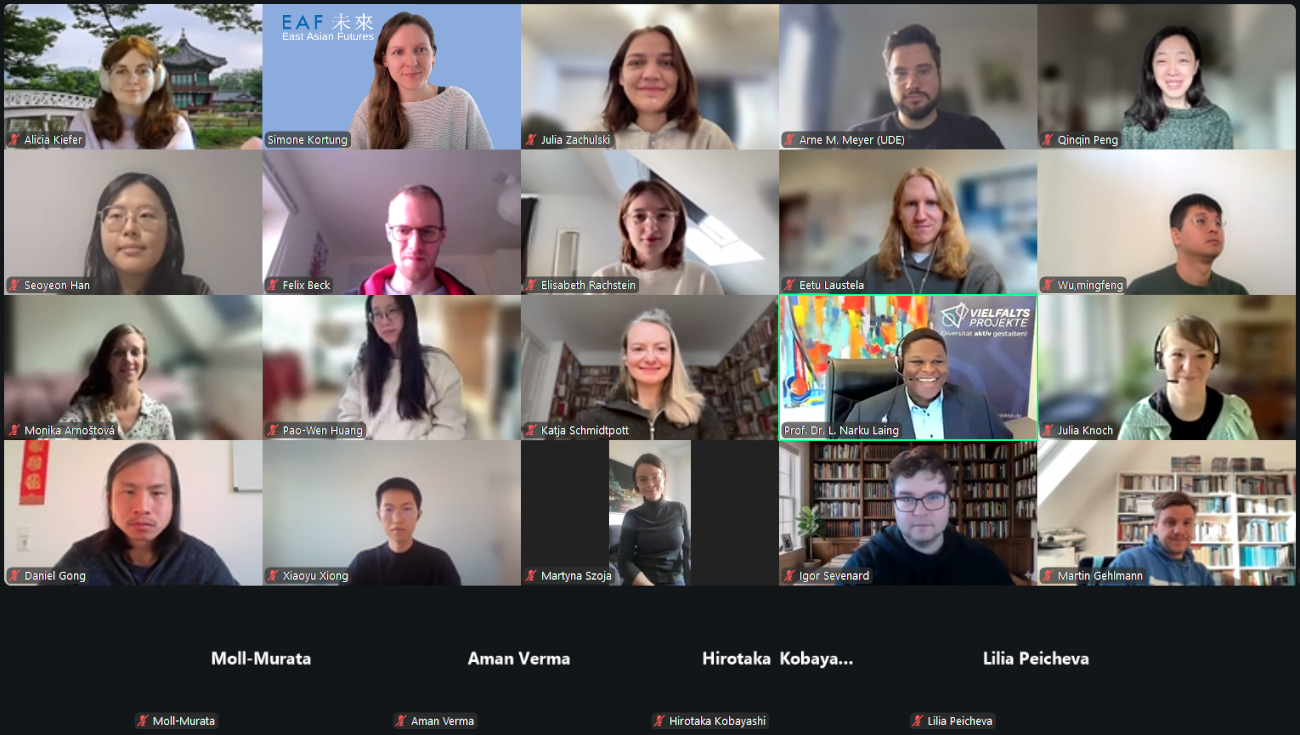
On November 6, 2026, the Research Training Group 2833 “East Asian Futures” held its annual Equal Opportunities Workshop, led by Prof. Dr. Lorenz Narku LAING. The online event brought together members of the Research Training Group to explore different dimensions of diversity, examine mechanisms of discrimination, and discuss ways of fostering more inclusive academic environments.
Prof. Dr. Lorenz Narku LAING is Professor of Social Sciences and Racism Research at the Protestant University of Applied Sciences Bochum, founder and managing director of Vielfaltsprojekte GmbH, and a certified diversity trainer. Drawing on his academic expertise and practical experience advising organisations across various sectors, he addressed racism, social inequality, and discrimination as interconnected phenomena that shape both everyday interactions and institutional structures.
Using practical examples and conceptual frameworks, Prof. LAING encouraged participants to question established assumptions, recognise less visible forms of discrimination, and reflect on the role of institutions in promoting equal opportunities. Particular attention was given to the structures and norms shaping academic careers. The concept of the “invisibility of the norm” illustrated how dominant perspectives and institutional expectations often remain unquestioned, while the notion of the “leaky pipeline” highlighted persistent gender disparities at different stages of academic careers.
The workshop combined presentations with interactive discussions and breakout sessions, giving participants the opportunity to exchange perspectives, reflect on personal experiences, and engage with questions of diversity and inclusion. Interactive surveys at the beginning and end of the event provided additional opportunities to reflect on individual perspectives and learning experiences. Participants initially shared their expectations, which included gaining new perspectives, recognising personal biases, developing approaches to greater inclusion, and learning more about the challenges faced by international scholars in European academic environments.
In their concluding reflections, participants emphasised the importance of continuous self-reflection and reassessing established perspectives. They also highlighted the value of research from the Global South and the possibility of creating more inclusive academic structures. The workshop thus offered an opportunity to look beyond individual experiences and consider the broader social and institutional conditions that shape inequality. It encouraged participants to question existing norms and reflect on how they can contribute to more inclusive academic environments, underlining that meaningful change requires ongoing awareness, reflection, and commitment.