From July 21 to 25, 2026, several members of the Research Training Group GRK 2833 “East Asian Futures” attended the 26th Biennial Conference of the European Association for Chinese Studies (EACS) held at Ca’ Foscari University of Venice, Italy. During Session 1 of the Anthropology and Sociology section on July 21, 2026, affiliated postdoctoral researcher Dr. Monika ARNOŠTOVÁ presented a paper titled “Re-orienting Futures: Alternative Employment and Work-Life Balance among Shanghai’s Youth” as part of the panel “Negotiating Work and Family Obligations in China” (paper abstracts at the end of this article).
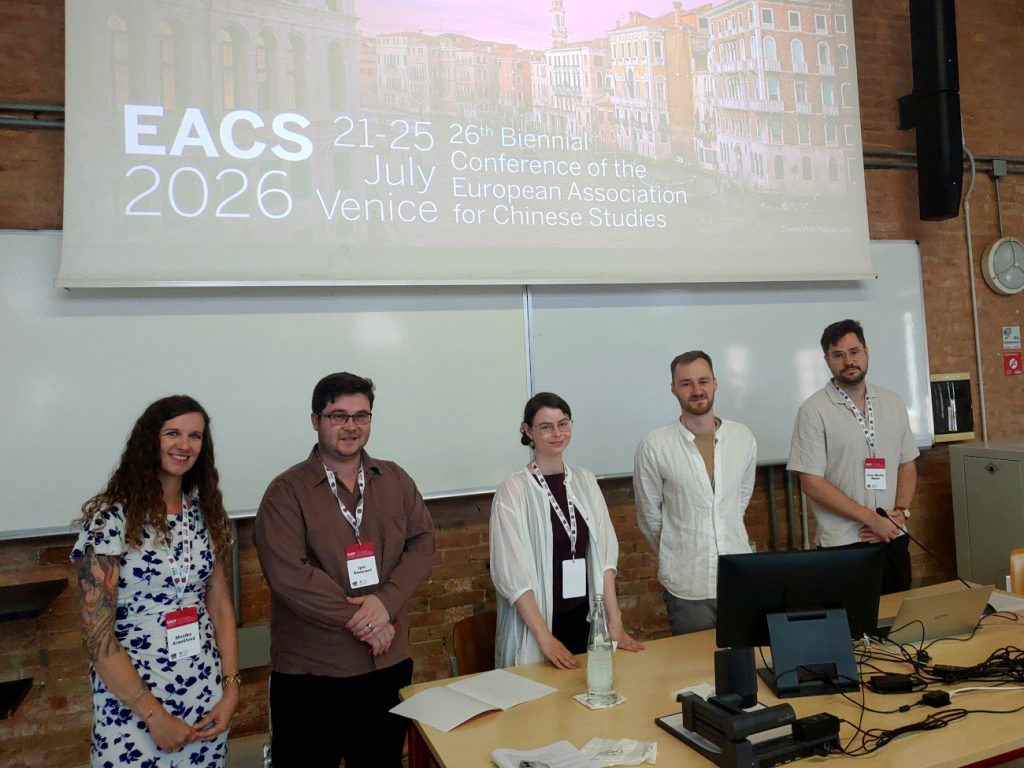
On July 23, she furthermore chaired the 8th session of the Politics and International Relations section with the panel “Chinese Futures of World Order: Normative Visions, Security Regimes, and Space Leadership”. As part of the panel, four other members of the RTG presented their research. From the first cohort of doctoral students, Igor SEVENARD talked about “Superposed Futures: Performing Success and Failure in China’s Global Community of Shared Future”. He was followed by three members of the second cohort presenting their papers: Konrad BÖHM (“Visions of Future and World Order in Chinese Schools of International Relations”), Martyna SZOJA (“China’s Nuclear Non-Proliferation Apparatus: Current and Future Directions”), and Arne Moritz MEYER (“Chinese Futures of World Order: Normative Visions, Security Regimes, and Space Leadership”).
The panel investigated how China shapes possible futures of the international order through its engagement in normative concepts, security institutions, and outer space governance, moving beyond simplistic portrayals of China as merely a status quo or revisionist power. It explored the tensions and strategies in China’s global governance, highlighting its dual role as both a promoter of new global projects and a pragmatic actor within existing frameworks, while situating itself within debates on the temporal dimensions of world politics. Through interdisciplinary analysis, the panel examined how Chinese visions of world order are articulated in multilateral settings, how discourses construct futures, and how initiatives like space exploration reflect China’s ambition to foster new forms of global cooperation, ultimately offering new lenses for understanding China’s influence in shaping the global order.
Abstract of Monika ARNOŠTOVÁ’s presentation
Youth in China are confronting a convergence of macro-economic pressures that have driven youth unemployment to its current 17.3 %. However, scholars warn that the true figure remains higher. This environment fuels “involution” (内卷), a relentless competition in education and work that yields diminishing returns, and a growing awareness that the prosperity enjoyed by older generations may be out of reach. Young educated Chinese respond in diverse ways. Some enter the platform economy as delivery drivers or streamers, viewing these jobs as temporary solutions. Others adopt “lying flat” (躺平) by withdrawing from the labour market, while another segment pursues additional qualifications (master’s or doctoral degrees) to postpone employment. A further group, often children of recently retired parents, become “full-time children” (全职⼦⼥), providing household support in exchange for modest allowances. This study investigates how Shanghai’s educated youth (23-35 years, bachelor’s degree or higher) negotiate work-life balance and alternative employment arrangements. Drawing on 30 in-depth interviews conducted in autumn 2024 across multiple industries, the research examines strategies for securing employment, the appeal of non-standard work models, and temporary labour-market exit. Particular attention is given to gendered dimensions of “lying flat” as a counter-strategy to intensified work and family pressures. Findings illuminate the evolving attitudes toward work, leisure, and familial responsibility among China’s emerging generation.
Abstract of Igor SEVENARD’s presentation
China’s vision for a Global Community of Shared Future (GCSF) exists in a state of paradox, appearing simultaneously to be gaining traction and failing to launch. This article posits that the GCSF’s success and failure are not future outcomes to be determined, but coexisting ‘present futures’ being actively performed by political actors in the now. The concept of ‘superposition,’ derived from physics, is introduced as a discursive analogy to describe this coexistence of mutually incompatible expectations. A qualitative analysis of key Chinese official texts, leadership speeches, and multilateral documents from 2013-2025 reveals how these rival futures are enacted. Chinese state discourse performs success by compressing time, escalating modality (‘shall,’ ‘must’), and anchoring the GCSF to established doctrines and initiatives like the BRI, thereby constructing it as an already unfolding reality. In parallel, international responses perform failure through the diplomatic strategies of omission, dilution, and translation politics in multilateral forums, effectively constraining the initiative’s normative diffusion. Ultimately, this article offers a temporally explicit account of Chinese norm entrepreneurship as a contest of expectation management, providing a portable framework for analyzing how world-order projects live in multiple temporalities at once.
Abstract of Konrad BÖHM’s presentation
This paper compares visions of the future international order across distinct “Chinese Schools” of International Relations (IR). It investigates how future orientation shapes interpretations of the present and past, and vice versa. The paper offers insights into Chinese elite thinking about the international order and enhances theoretical models for studying the social role of the future. The research analyzes shared and divergent temporal narratives among scholars of Moral Realism, Tianxia systems theory, and relational approaches to global order. employing quantitative and qualitative text analysis, it compares academic publications and public statements across three dimensions: (1) critiques of the current global order, (2) invocations of Chinese historical experience and philosophical concepts, and (3) visions of a desired future international order. Anchored in debates on political mythology and political ideology, the paper frames Chinese IR schools as illustrative cases of the broader mechanisms through which future-oriented narratives reconstruct history and contemporary politics. Findings indicate that these scholarly communities advance distinct and internally varied future imaginaries, underscoring the heterogeneity of elite Chinese discourse and the negotiated nature of future-oriented aspirations.
Abstract of Martyna SZOJA’s presentation
China positions itself to play a constructive leadership role in sustaining and reforming the highly contested non-proliferation regime. Its nuclear non-proliferation apparatus has become increasingly vocal and influential. Yet China’s impact remains ambiguous due to internal contradictions between its strategic ambitions and declared support. Such a dualistic posture may, in the future, generate uncertainty for global nuclear governance. Analysis of China’s non-proliferation structures, particularly within the MoFA, complemented by a review of official submissions to the UN and speeches delivered by Chinese representatives, offers an objective perspective on the effectiveness of China’s declarations. This study examines China’s participation in multilateral forums, its adoption of confidence-building and risk-reduction measures, and its promotion of initiatives such as No First Use and proposals for future-oriented frameworks. Particular attention is given to how China articulates its role, presents its identity as a responsible major power, and seeks to shape norms within institutions associated with the Nuclear Non-Proliferation Treaty. This article contributes to scholarship by providing one of the first systematic assessments of China’s institutional capacity and strategic intent within the global non-proliferation regime. It clarifies whether China functions as a normative supporter, selective adaptor, or emerging leader in non-proliferation efforts. The analysis shows that China’s apparatus has become increasingly assertive and professionalized, marked by expanded diplomatic activity, deeper engagement in negotiations, and occasional steps toward transparency. However ongoing nuclear modernization, limited openness, and uneven commitment to verification continue to cast doubt on China’s overall credibility.
Abstract of Arne Moritz MEYER’s presentation
China’s manned spaceflight program has emerged as a key instrument of its outer space leadership pursuit. The paper argues that China frames itself as an alternative to established space manned programs (e.g. ISS), especially for Global South countries, to act as a “responsible major space power” and technological global leader. This role claim and the current role performance are discussed through the lens of a role theory approach. A core contribution of this paper is the application of a leadership role analysis on still developing Chinese outer space programs with limited amount of international cooperation. For this purpose, the example of the domestically build Tiangong-3 Space Station is chosen to determine how China promotes an inclusive approach on outer space cooperation to contest the current western dominated access to manned spaceflight. Drawing on policy documents, mission data, and diplomatic statements, and the current debate between western and Chinese experts, this paper examines the role claim and role performance according to Harnisch’s four leadership auxiliary roles (pioneer, agenda-setter, representative, and mediator). Building on these findings, the paper provides a detailed explanation of Chinese-led manned spaceflight, the utilization of cooperation to solidify a leadership role claim and an outlook on how China is planning to shape and lead the future of outer space exploration. Preliminary findings show that manned spaceflight cooperation is currently still limited to a single Chinese-Pakistani joint mission. The year 2030 is identified as a future turning point, due to the predicted deorbiting of ISS.