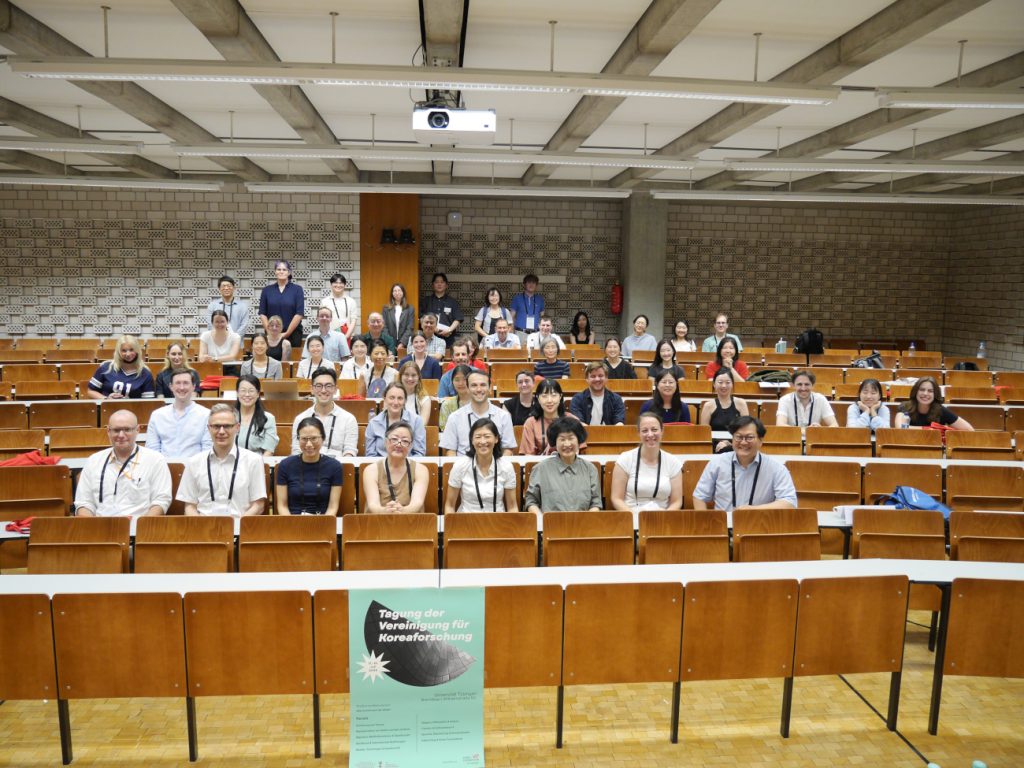
In July 2026, Dr. Martin GEHLMANN, Dr. des. Youlim KIM, and doctoral researchers Seoyeon HAN and Minkyun PARK of the Research Training Group GRK 2833 “East Asian Futures” attended the conference of the Vereinigung für Koreaforschung (VfK) at Eberhard Karls University of Tübingen, Germany. The VfK Conference, held on 17 and 18 July 2026, brought together scholars and institutions in Korean Studies from Germany, Austria, and Switzerland. Covering fields ranging from history, religion, and philosophy to politics, sociology, media, literature, linguistics, and education, the conference provided a forum for interdisciplinary exchange and the presentation of current research on Korea.
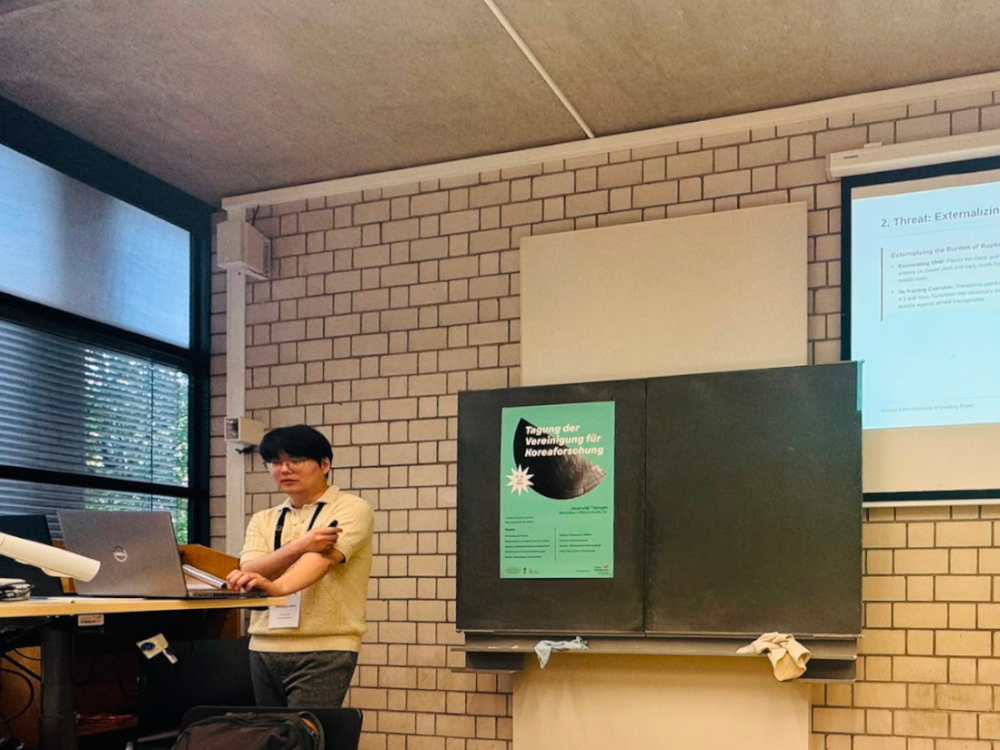
Dr. GEHLMANN, Dr. des. KIM, and Mr. PARK participated in the panel “Representations of Self and Other”, chaired by Prof. Dr. Felix SIEGMUND (Ruhr University Bochum) on July 17. The panel examined how identities and boundaries between the Self and Others are produced through travel writing, digital media, and documentary film.
Martin GEHLMANN presented his research on “Korea as China’s Future: Record of Things Heard and Seen in Korea (朝鮮聞⾒錄, 1918)”. His paper examined an anonymous Chinese travelogue published in 1918, which combined first-hand observations of Korea with material drawn from contemporary publications. The paper showed how the author expressed sympathy for Korea under Japanese colonial rule while simultaneously reproducing civilizational hierarchies and cultural stereotypes. Korea was thus constructed both as an object of empathy and as a cautionary example of China’s possible future should political reform fail.
Youlim KIM gave a talk titled “Negotiating the Labels: Self-Representations of Korean Unmarried Mothers in Digital Media Spaces”. Drawing on Multimodal Critical Discourse Analysis, her research examined YouTube content produced by unmarried mothers in South Korea between 2015 and 2025. The paper explored how these creators negotiate dominant ideas of motherhood, family, and gender through narratives, captions, thumbnails, and other visual elements. It argued that digital platforms do not amplify marginalized voices uniformly but selectively legitimize representations that remain compatible with established family norms. Nevertheless, these digital spaces allow unmarried mothers to challenge stigmatizing representations by foregrounding their own experiences and voices.
Minkyun PARK presented “From Memory War to Ontological Reassurance: Self and Other in The Birth of Korea”. His paper examined how the South Korean documentary constructs a coherent and morally intelligible narrative of national foundation, threat, and redemption. Drawing on ontological security theory, the presentation analyzed how the film produces both external and internal Others and offers ontological reassurance to audiences who identify with its interpretation of South Korean history. At the same time, the paper highlighted how the same narrative may generate insecurity among groups who reject its representation of the national past.
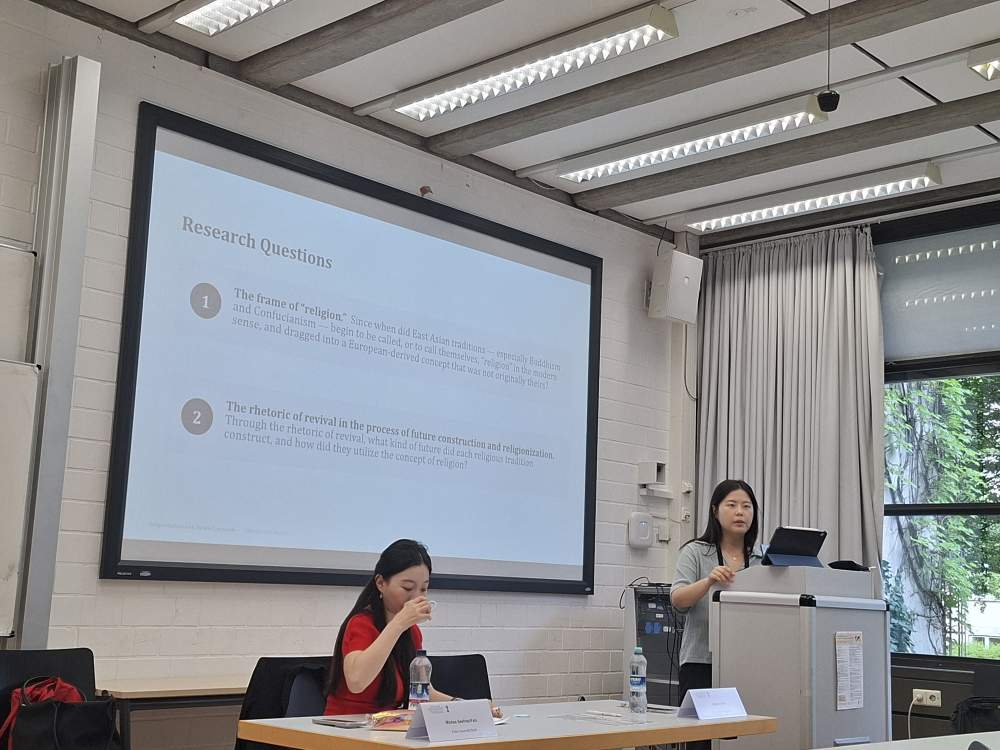
The following day, Seoyeon HAN participated in the panel “Religion, Philosophy and Discourse”, chaired by Minhee SEEFRIED-PARK (Freie Universität Berlin), where she presented “Religionization with Future Constructs in Modern Korea: Focusing on the Concept of ‘Revival’ in Confucian, Buddhist, and Protestant Rhetoric”. Her paper examined how the language of revival was employed in Korean religious discourse from the late nineteenth to the early twentieth century. Rather than merely expressing a desire to restore a declining past, revival terminology enabled religious actors to diagnose contemporary crises, redefine the social role of religion, and imagine renewed futures under the conditions of modernization and colonial rule. By comparing Confucian, Buddhist, and Protestant rhetoric, the paper identified a shared structure in which the present was represented as a period of decline and religion as a resource for constructing new moral and communal futures.
Participation in the VfK Conference offered the researchers an opportunity to discuss their ongoing projects with scholars from different areas of Korean Studies and to receive valuable feedback on their theoretical and methodological approaches. The conference also contributed to strengthening academic exchange between the Research Training Group and the wider German-speaking Korean Studies community.