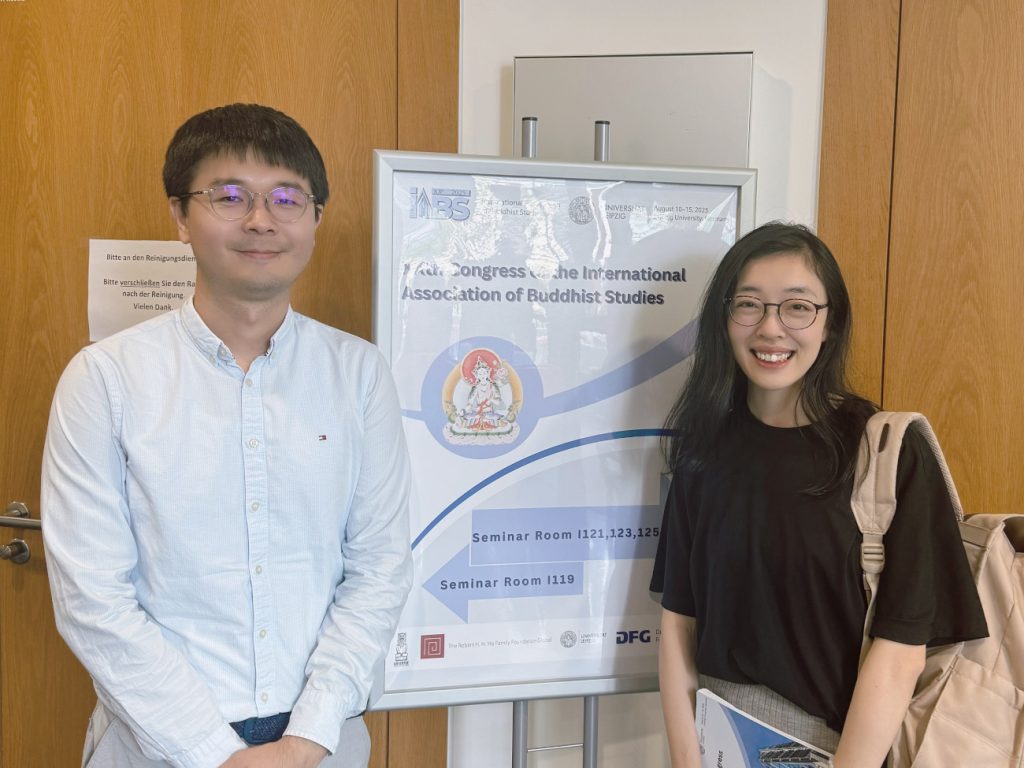
Affiliated Postdoctoral Researcher Dr. Qinqin PENG and Doctoral student Ming-Feng WU of the Research Training Group GRK 2833 “East Asian Futures” attended the XXth Congress of the International Association of Buddhist Studies (IABS), held at Leipzig University, Germany on August 10–15, 2025, with both joining a panel and giving presentations related to their respective research fields.
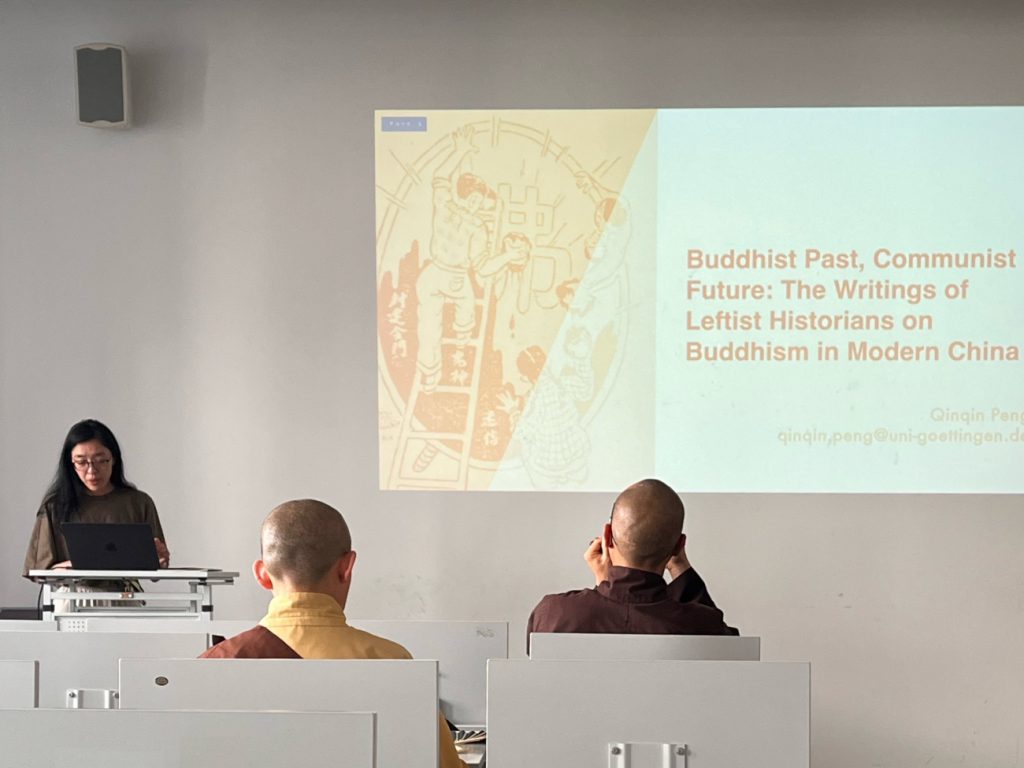
On August 13, Dr. PENG gave her presentation “Buddhist Past, Communist Future: The Writings of Leftist Historians on Buddhism in Modern China (1900-1949)” as part of Panel 10 titled “Buddhist Hermeneutics, Scholasticism, and Commentarial Techniques”, chaired by Prof. Rupert GETHIN (University of Bristol).
Abstract of Qinqin PENG’s presentation
There has long been significant tension between the Chinese Communist Party (CCP) and Buddhism. This tension is rooted not only in religious policies and socio-political factors but also in deep ideological differences. From labeling Buddhism as “superstition” in the early 20th century to the current emphasis on its “Sinicization,” the CCP’s discourse on Buddhism has shifted considerably over time, with many of these shifts framed through historical narratives. This study examines the “historicization” of Buddhism within the Marxist theoretical framework by focusing on the writings of leftist historians during the early 20th century (1900 to 1949). It investigates the early clashes between Buddhism and Marxist ideology before Marxism became the dominant and sole sanctioned ideology in the 1950s, offering insights into the transformation of the Buddhist epistemological system and the broader relationship between Buddhism, politics and intellectual thought in modern China.
The research explores key cases where Marxist historical perspectives were applied to the study of Chinese Buddhism in its early phases, focusing on prominent leftist historians such as Guo Moruo (1892–1978), Fan Wenlan (1893–1969), Ren Jiyu (1916–2009). By analyzing their discussions on topics such as the dissemination of Buddhism in China, the periodization of Buddhist history, and Buddhism’s impact on Chinese history, this study uncovers their perspectives on three key issues: 1) the historical and cultural significance of Buddhism, 2) the Sinicization of Buddhism, and 3) the relationship between Buddhism and politics and economics in various historical contexts. Meanwhile, by comparing these leftist historians’ interpretations with other contemporary discussions on Buddhist history within both academia and the Buddhist community, this study highlights the complex and multifaceted nature of modern Chinese Buddhist scholarship.
Although these leftist historians’ voices were neither systematic nor dominant in the field of Buddhist studies prior to 1949, their work is crucial for understanding the CCP’s official discourse on Buddhism, as well as the Party’s evolving definitions, interpretations, and attitudes towards Buddhism.
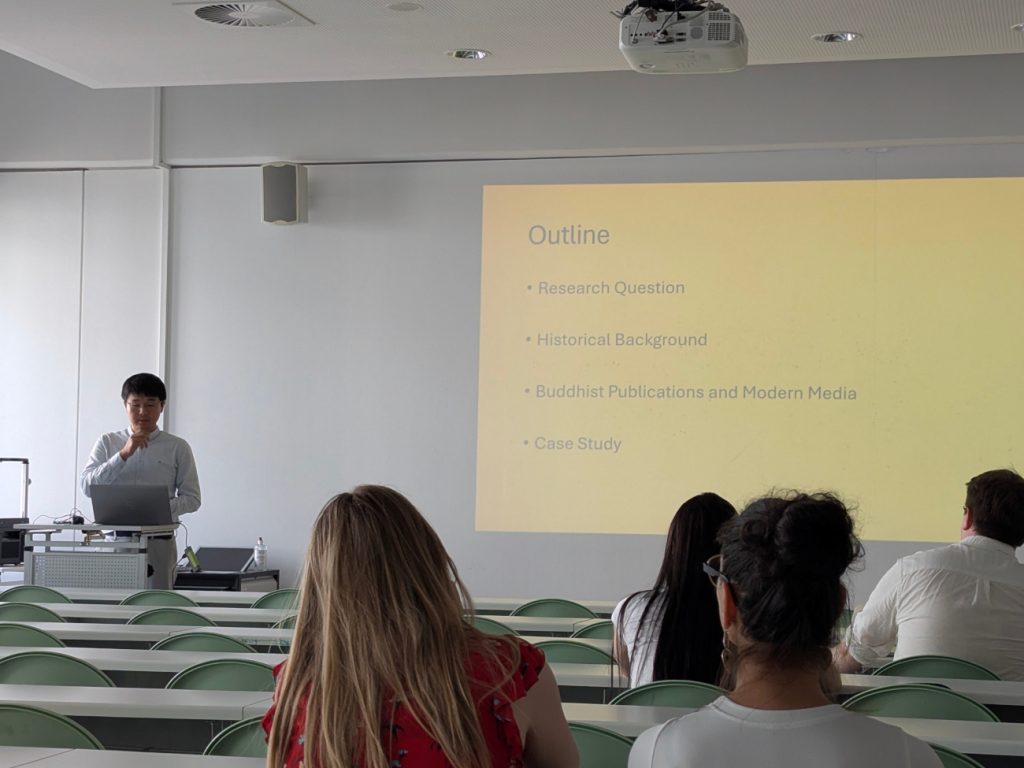
As part of Panel 14 “East Asian Buddhism (3)”, chaired by Prof. Anna ANDREEVA (Ghent University), Ming-Feng WU delivered his findings on “Future Through Buddhist Terminology: Modern Chinese Buddhist Discourse on Two Truths” on August 15.
Abstract of Ming-Feng WU’s presentation
As a foundational Buddhist concept, the Two Truths doctrine has been frequently employed by both Buddhist and non-Buddhist intellectuals throughout Chinese history. This study utilizes a conceptual history approach to analyze classical texts, modern Chinese Buddhist periodicals, and intellectual debates to examine how this doctrine has been reimagined to articulate visions of the future in modern China.
By tracing its historical development, this research reveals how the Two Truths doctrine has functioned as a conceptual bridge between tradition and modernity, including being deployed as a framework for understanding different types of knowledge, a theoretical foundation for political reform, and a philosophical basis for imagining China’s future.
Through an examination of the doctrine’s deployment across diverse discourse communities, this study illuminates how traditional religious concepts maintain their relevance while adapting to modern contexts. As such, it contributes to our understanding of how traditional religious concepts evolve and maintain relevance in modern discourse. By examining the Two Truths doctrine’s deployment across different contexts and communities, this study demonstrates the dynamic role of Buddhist concepts in shaping modern Chinese intellectual history and visions of the future.