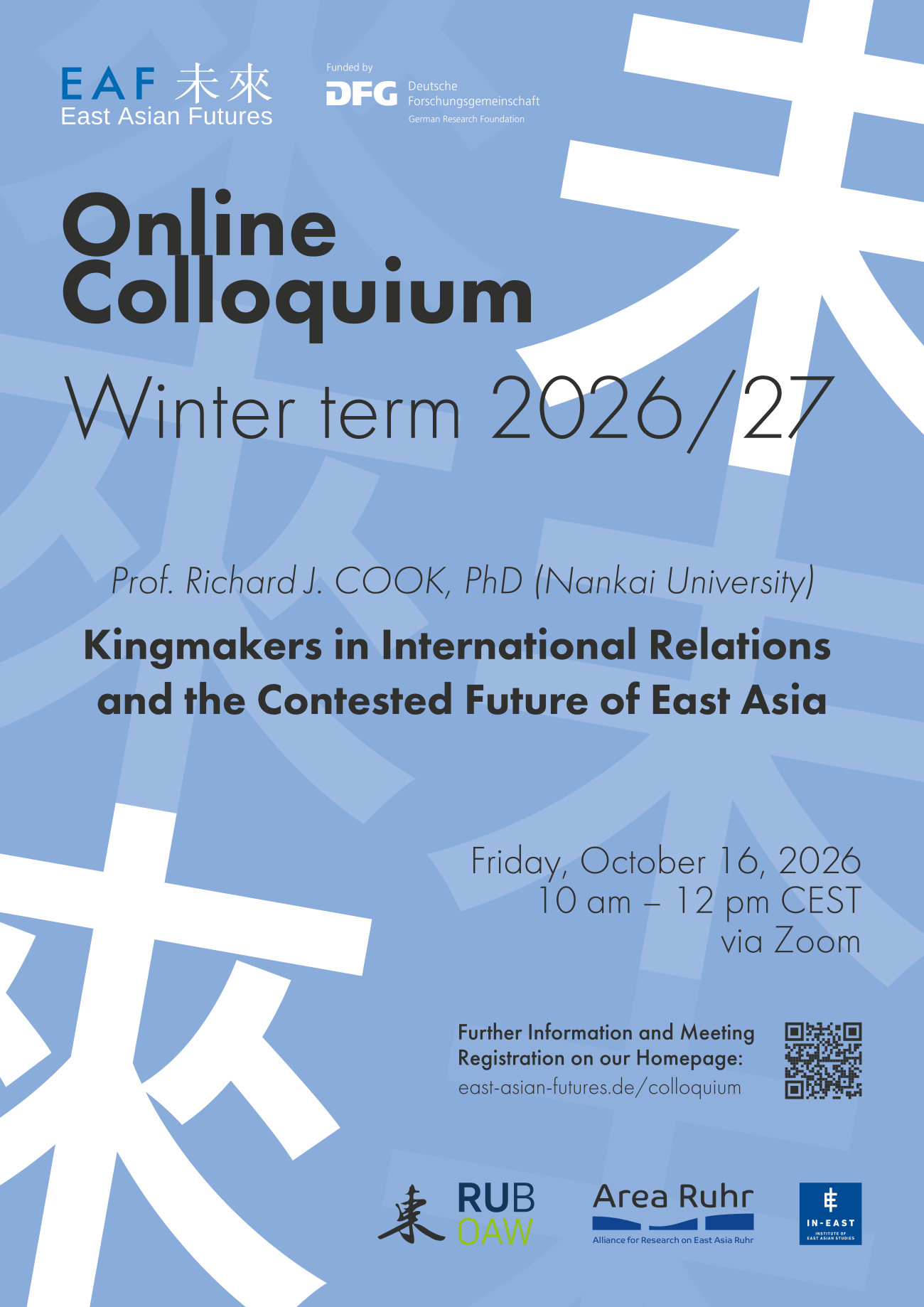
The Online Colloquium series of the Research Training Group GRK 2833 “East Asian Futures” will be renewed for the winter term of 2026/27, starting with an online lecture by Prof. Richard J. COOK, PhD. You are cordially invited to attend.
Prof. Richard J. COOK, PhD (Nankai University)
“Kingmakers in International Relations and the Contested Future of East Asia”
Friday, October 16, 2026, 10 am – 12 pm (Central European Summer Time)
Abstract
“The strong do what they can and the weak suffer what they must.” This Thucydidean maxim from the Melian Dialogue has shadowed international relations for more than two millennia, hardening into an axiom. This book challenges that assumption. When great powers compete, the balance between them is rarely settled by their own strength alone. Each needs others on its side — states whose capability, position, or allegiance can tip the scales. That need, Cook, Ohle, and Han argue, inverts the Melian logic, conferring power on those caught in the middle: the “power of the weak” paradox. And from this paradox emerge kingmakers — actors that can decide who wins by choosing whom to support. This paradigm has recurred long throughout history and stands as a lesson for the future. In China’s Warring States era, Chu’s fateful alignment choice accelerated Qin’s path to unification. In the Peloponnesian War, Corcyra’s appeal for alliance dragged Athens and Sparta into a generation of conflict. In the First Punic War, the Mamertines’ oscillation between Carthage and Rome converted a Sicilian quarrel into Rome’s rise to Mediterranean primacy. And on the Field of Gold Cloth, Henry VIII wore the motto cui adhaereo praeest — “the party to which I adhere getteth the upper hand.” Kingmaking, the authors show, is a recurring yet overlooked structural feature of great power competition across the ages. Like in bygone great power competitions, kingmaking is a crucial feature of the Asia-Pacific today. The likes of Japan, South Korea, the Philippines, and Vietnam sit along a geopolitical fault line between China and the United States, courted by both precisely because their alignment can tip the regional balance. That courtship grants them agency, but mattering is fraught with risk. As the China-US great power competition intensifies, these linchpin states undertake a kingmaker’s role and confront the Kingmaker’s Conundrum: the perilous choice of alignment, and tip the balance of power. Asia-Pacific Secondary States as Kingmakers ranges from ancient statecraft to contemporary alignment politics to offer a new framework for understanding how pivotal states will not merely shape the defining competition of our time, but decisively forge the future of East Asia and the wider balance of power.
Bio
Richard J. COOK, Ph.D., is an Associate Professor of International Relations at the Department of International Relations, Zhou Enlai School of Government, Nankai University, China. He is also a senior course convenor for the Nankai University-Glasgow University Joint Graduate School. His main research focuses on China-US Relations, International Relations of the Asia-Pacific, Great Power Competition, Foreign Policy Behaviour of Small and Middle Powers, and International Relations Theory. He is lead author of the Asia-Pacific Secondary States as Kingmakers: Alignment Roles in the China-US Strategic Competition (London and New York: Routledge, 2025). His work has appeared in Review of International Studies, Politics, Journal of International Relations and Development, International Relations, The Pacific Review, The Chinese Journal of International Politics, The Journal of Chinese Political Science, Europe-Asia Studies, Journal of Latin American Studies, Korea Observer, Journal of Political Science Education, The Journal of Eurasian Studies, and The Journal of Contemporary China, among others. Additionally, he has contributed to outlets such as Global Policy, The Diplomat, E-International Relations, Tech Policy Press, and The Loop – ECPR.
Organizer
Research Training Group 2833 “East Asian Futures: Visions and Realizations on National, Transregional and Global Scales”, Ruhr University Bochum and University of Duisburg-Essen.
Access to the meeting
https://ruhr-uni-bochum.zoom-x.de/j/64692001236?pwd=x1CrfLQaTqLfmG9oGxdAiERyrTw6ag.1
Meeting ID: 646 9200 1236 | Password: 739945